
1990-2019 年全球疾病负担研究:14 岁以下儿童先天性出生缺陷负担:年龄-时期-队列分析。
The congenital birth defects burden in children younger than 14 years of age, 1990 - 2019: An age-period-cohort analysis of the global burden of disease study.
机构信息
Department of Plastic and Reconstructive Surgery, Shanghai Ninth People's Hospital, Shanghai Jiao Tong University School of Medicine, Shanghai, China.
Department of Cardiology, Shanghai Ninth People's Hospital, Shanghai Jiao Tong University School of Medicine, Shanghai, China.
出版信息
J Glob Health. 2024 Jan 19;14:04012. doi: 10.7189/jogh.14.04012.
BACKGROUND
This study aims to delineate the burden of congenital birth defects (CBDs) in children under 14 years of age from 1990 to 2019, using an age-period-cohort framework to analyse data from the Global Burden of Disease Study (GBD).
METHODS
Data on prevalence cases, age-standardised prevalence rates (ASPRs), death cases, and age-standardised death rates (ASDRs) of congenital birth defects (CBDs) from 1990 to 2019 were obtained from GBD 2019. Using this data set, we conducted an age-period-cohort (APC) analysis to examine patterns and trends in mortality, prevalence, and disability-adjusted life years (DALYs) associated with CBDs, while exploring correlations with age, time periods, and generational birth cohorts. Furthermore, to quantify the temporal trends, we calculated the estimated annual percentage changes (EAPCs) for these parameters.
RESULTS
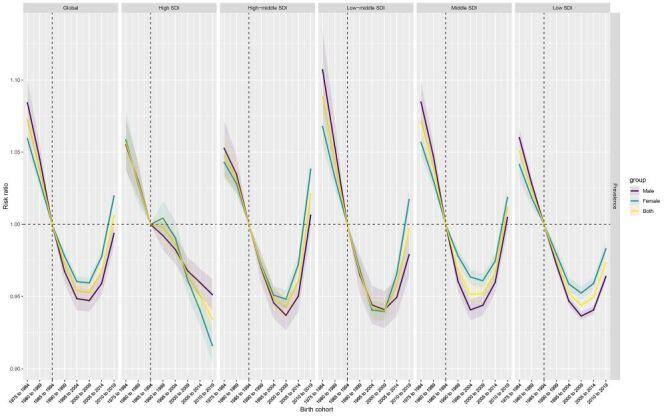
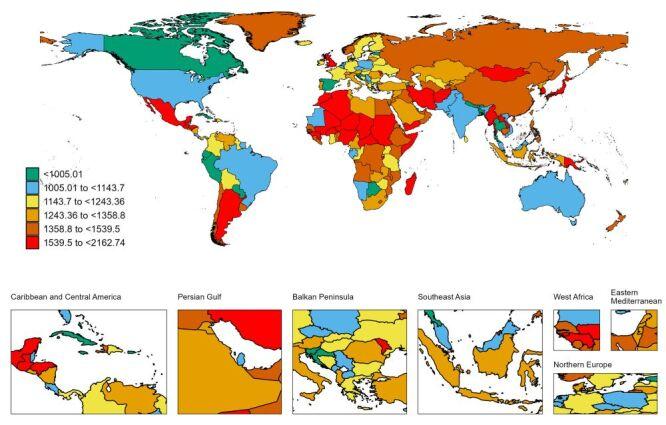
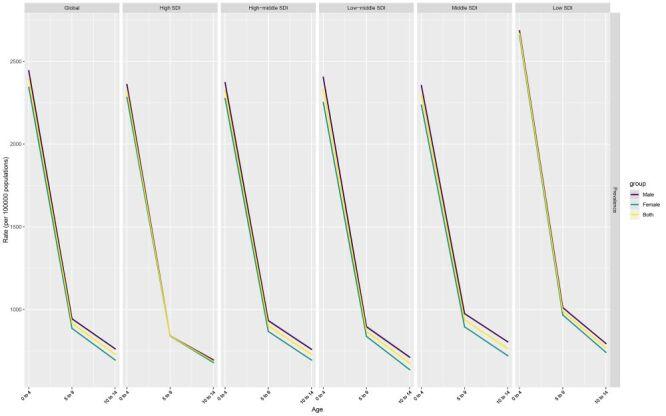
The global prevalence of CBDs decreased from 1404.22 to 1301.66 per 100 000 with an EAPC of -0.18% from 1990 to 2019. CBD mortality decreased by 42.52% between 1990 and 2019, with the global age-standardised death rate declining from 49.72 to 25.58 per 100 000. The age-standardised DALY rate decreased from 4529.16 to 2393.61 per 100 000. Prevalence declined most notably among older children. The risk of CBDs reached its lowest during adolescence (10-14 years) across all regions. The most recent period (2015-2019) showed a reduced risk of prevalence compared to 2000-2004. Earlier birth cohorts displayed declining tendencies followed by slight increases in risk.
CONCLUSIONS
This study demonstrates encouraging global reductions in the burden of CBDs among children over the past three decades. Prevalence, mortality, and DALYs attributable to CBDs have exhibited downward trajectories, although regional disparities remain. APC analysis provides valuable insights to inform prevention and management strategies for pediatric CBDs.
背景
本研究旨在利用年龄-时期-队列框架,根据全球疾病负担研究(GBD)的数据,描绘 1990 年至 2019 年 14 岁以下儿童先天性出生缺陷(CBDs)的负担情况。
方法
从 GBD 2019 中获取 1990 年至 2019 年 CBD 患病率病例、年龄标准化患病率(ASPRs)、死亡病例和年龄标准化死亡率(ASDRs)数据。使用该数据集,我们进行了年龄-时期-队列(APC)分析,以检查 CBD 相关死亡率、患病率和残疾调整生命年(DALYs)的模式和趋势,同时探索与年龄、时期和代际出生队列的相关性。此外,为了量化时间趋势,我们计算了这些参数的估计年百分比变化(EAPCs)。
结果
全球 CBD 患病率从 1990 年的 1404.22 降至 2019 年的 1301.66/100000,EAPC 为-0.18%。1990 年至 2019 年,CBD 死亡率下降了 42.52%,全球年龄标准化死亡率从 49.72 降至 25.58/100000。年龄标准化 DALY 率从 4529.16 降至 2393.61/100000。患病率下降最明显的是年龄较大的儿童。在所有地区,CBD 风险在青少年(10-14 岁)期间达到最低。与 2000-2004 年相比,最近时期(2015-2019 年)的患病率风险降低。早期出生队列的风险呈下降趋势,随后略有上升。
结论
本研究表明,在过去三十年中,全球儿童 CBD 负担有所减轻。尽管存在地区差异,但 CBD 患病率、死亡率和 DALYs 呈下降趋势。APC 分析为制定小儿 CBD 预防和管理策略提供了有价值的信息。



 Zotero 插件