
突变特征动力学表明,宿主抗病毒分子驱动了 SARS-CoV-2 的进化能力。
Mutational signature dynamics indicate SARS-CoV-2's evolutionary capacity is driven by host antiviral molecules.
机构信息
Medical Research Council - University of Glasgow Centre for Virus Research, School of Infection and Immunity, Glasgow, Scotland, United Kingdom.
School of Computing Science, University of Glasgow, Glasgow, Scotland, United Kingdom.
出版信息
PLoS Comput Biol. 2024 Jan 25;20(1):e1011795. doi: 10.1371/journal.pcbi.1011795. eCollection 2024 Jan.
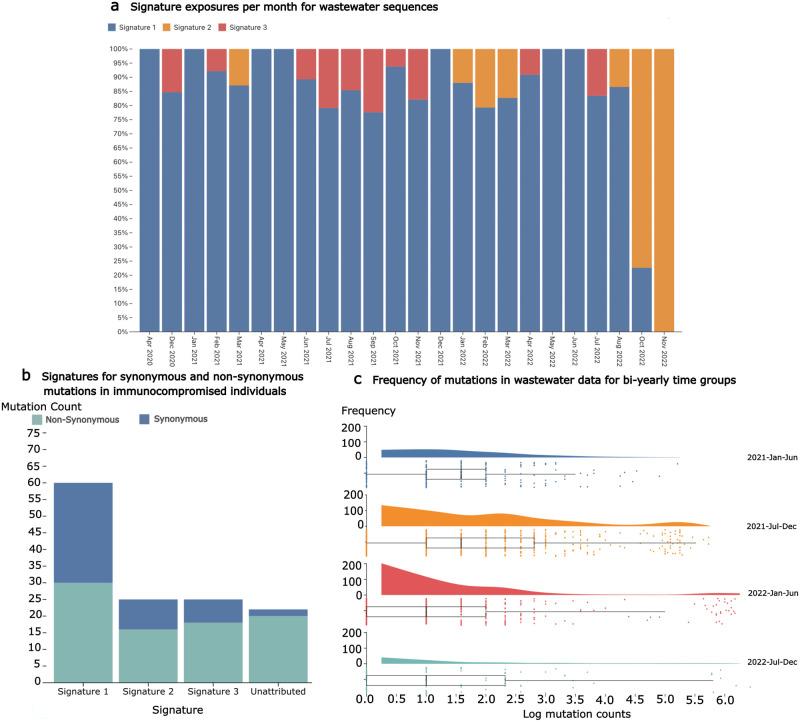
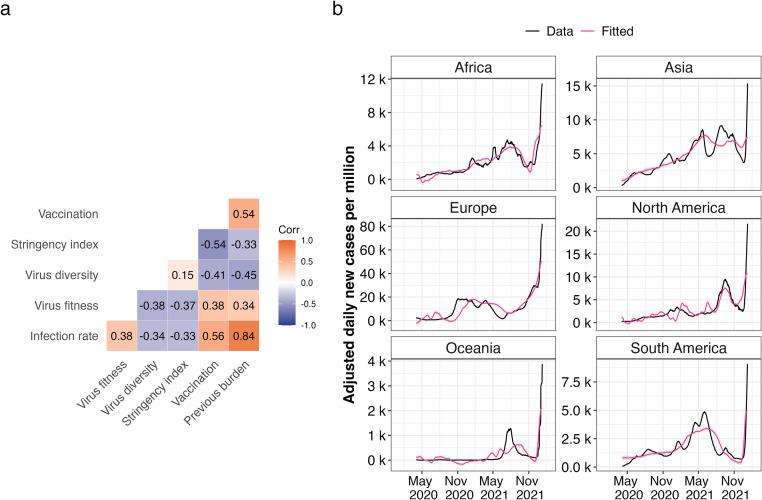
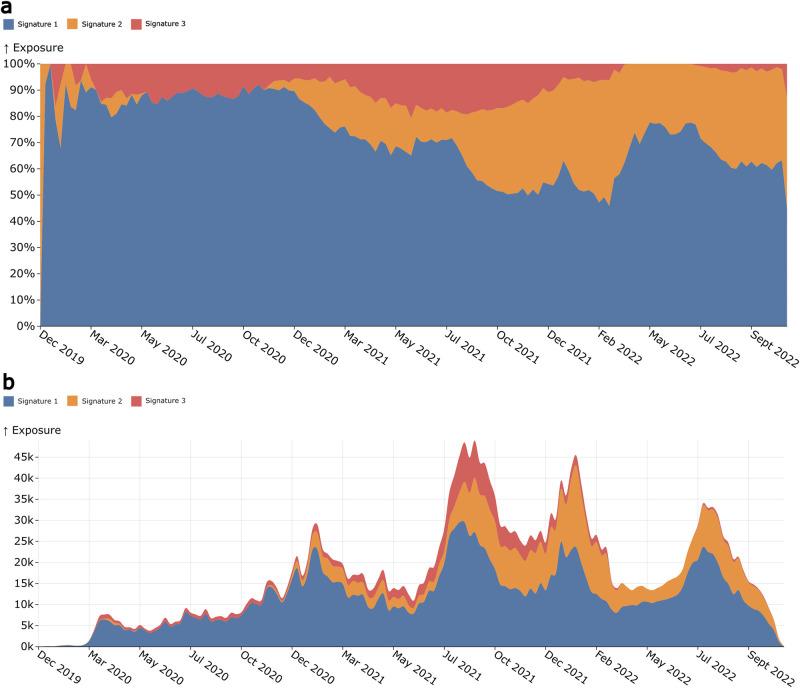
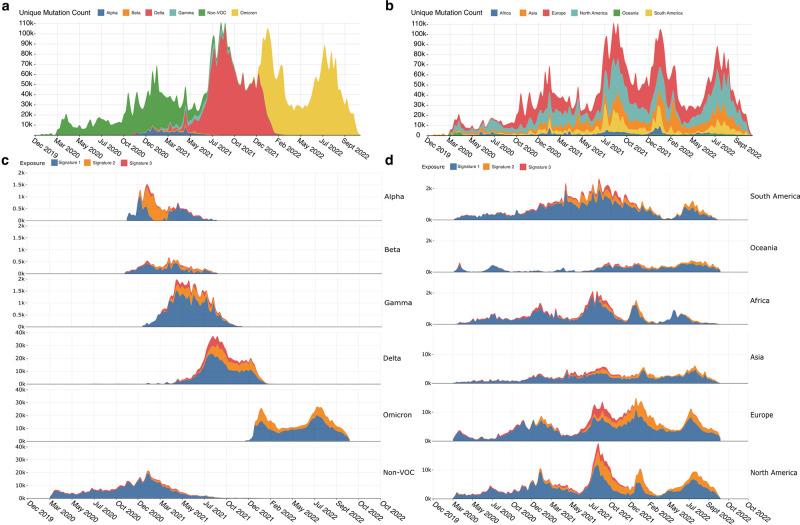
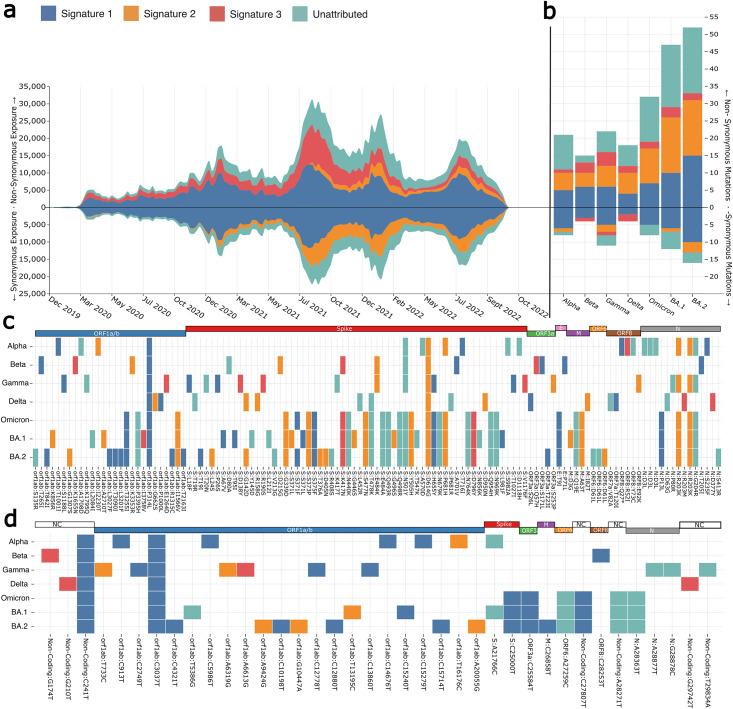
The COVID-19 pandemic has been characterised by sequential variant-specific waves shaped by viral, individual human and population factors. SARS-CoV-2 variants are defined by their unique combinations of mutations and there has been a clear adaptation to more efficient human infection since the emergence of this new human coronavirus in late 2019. Here, we use machine learning models to identify shared signatures, i.e., common underlying mutational processes and link these to the subset of mutations that define the variants of concern (VOCs). First, we examined the global SARS-CoV-2 genomes and associated metadata to determine how viral properties and public health measures have influenced the magnitude of waves, as measured by the number of infection cases, in different geographic locations using regression models. This analysis showed that, as expected, both public health measures and virus properties were associated with the waves of regional SARS-CoV-2 reported infection numbers and this impact varies geographically. We attribute this to intrinsic differences such as vaccine coverage, testing and sequencing capacity and the effectiveness of government stringency. To assess underlying evolutionary change, we used non-negative matrix factorisation and observed three distinct mutational signatures, unique in their substitution patterns and exposures from the SARS-CoV-2 genomes. Signatures 1, 2 and 3 were biased to C→T, T→C/A→G and G→T point mutations. We hypothesise assignments of these mutational signatures to the host antiviral molecules APOBEC, ADAR and ROS respectively. We observe a shift amidst the pandemic in relative mutational signature activity from predominantly Signature 1 changes to an increasingly high proportion of changes consistent with Signature 2. This could represent changes in how the virus and the host immune response interact and indicates how SARS-CoV-2 may continue to generate variation in the future. Linkage of the detected mutational signatures to the VOC-defining amino acids substitutions indicates the majority of SARS-CoV-2's evolutionary capacity is likely to be associated with the action of host antiviral molecules rather than virus replication errors.
新冠疫情的特点是由病毒、个体人类和人口因素决定的特定变体特异性波浪。SARS-CoV-2 变体是通过其独特的突变组合定义的,自 2019 年底这种新型人类冠状病毒出现以来,病毒明显适应了更有效的人类感染。在这里,我们使用机器学习模型来识别共享特征,即常见的潜在突变过程,并将这些特征与定义关注变体(VOC)的突变子集联系起来。首先,我们检查了全球 SARS-CoV-2 基因组和相关元数据,以确定病毒特性和公共卫生措施如何通过回归模型影响不同地理位置的感染病例数量波动,从而确定感染波的大小。这项分析表明,正如预期的那样,公共卫生措施和病毒特性都与报告的区域 SARS-CoV-2 感染数量的波浪有关,这种影响因地理位置而异。我们将此归因于内在差异,例如疫苗接种率、检测和测序能力以及政府严格程度的有效性。为了评估潜在的进化变化,我们使用非负矩阵分解(NMF)并观察到三个独特的突变特征,它们在替代模式和 SARS-CoV-2 基因组中的暴露方面具有独特性。特征 1、2 和 3 偏向 C→T、T→C/A→G 和 G→T 点突变。我们假设将这些突变特征分配给宿主抗病毒分子 APOBEC、ADAR 和 ROS。我们观察到在大流行中,从主要的特征 1 变化到越来越高的特征 2 变化的相对突变特征活性的转变。这可能代表着病毒和宿主免疫反应相互作用方式的变化,并表明 SARS-CoV-2 未来可能会继续产生变异。检测到的突变特征与 VOC 定义的氨基酸替换的联系表明,SARS-CoV-2 的大部分进化能力可能与宿主抗病毒分子的作用有关,而不是与病毒复制错误有关。


 Zotero 插件