
2019冠状病毒病mRNA疫苗初免系列和加强剂量在心血管疾病患者中诱导的体液和细胞反应:一项纵向研究
Humoral and Cellular Response Induced by Primary Series and Booster Doses of mRNA Coronavirus Disease 2019 Vaccine in Patients with Cardiovascular Disease: A Longitudinal Study.
作者信息
Ishihara Yuya, Naruse Hiroyuki, Fujigaki Hidetsugu, Murakami Reiko, Ando Tatsuya, Sakurai Kouhei, Uehara Komei, Shimomae Koki, Sakaguchi Eirin, Hattori Hidekazu, Sarai Masayoshi, Ishii Junnichi, Fujii Ryosuke, Ito Hiroyasu, Saito Kuniaki, Izawa Hideo
机构信息
Department of Clinical Laboratory, Fujita Health University Hospital, Toyoake 470-1192, Japan.
Department of Clinical Pathophysiology, Fujita Health University Graduate School of Health Sciences, Toyoake 470-1192, Japan.
出版信息
Vaccines (Basel). 2024 Jul 17;12(7):786. doi: 10.3390/vaccines12070786.
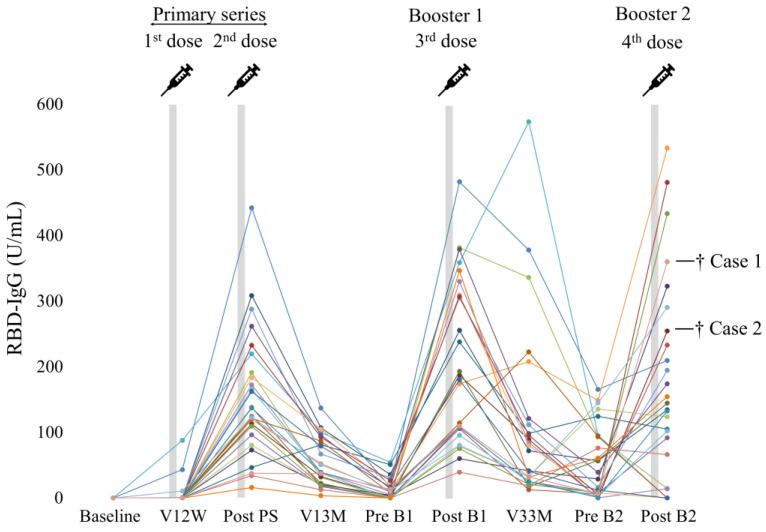
Preexisting cardiovascular disease (CVD) is a pivotal risk factor for severe coronavirus disease 2019 (COVID-19). We investigated the longitudinal (over 1 year and 9 months) humoral and cellular responses to primary series and booster doses of mRNA COVID-19 vaccines in patients with CVD. Twenty-six patients with CVD who received monovalent mRNA COVID-19 vaccines were enrolled in this study. Peripheral blood samples were serially drawn nine times from each patient. IgG against the severe acute respiratory syndrome coronavirus 2 (SARS-CoV-2) spike receptor-binding domain (RBD) was measured using an enzyme-linked immunosorbent assay. The numbers of interferon-γ-releasing cells in response to SARS-CoV-2 peptides were measured using an enzyme-linked immunospot assay. The RBD-IgG titers increased 2 weeks after the primary series and booster vaccination and waned 6 months after vaccination. The S1-specific T cell responses in patients aged < 75 years were favorable before and after booster doses; however, the Omicron BA.1-specific T cell responses were poor. These results suggest that regular vaccination is useful to maintain long-term antibody levels and has implications for booster dose strategies in patients with CVD. Additional booster doses, including Omicron variant-adapted mRNA vaccines, may be recommended for patients with CVD, regardless of age.
既往心血管疾病(CVD)是2019冠状病毒病(COVID-19)重症的关键危险因素。我们调查了心血管疾病患者对mRNA COVID-19疫苗初免系列和加强剂量的纵向(超过1年9个月)体液和细胞反应。本研究纳入了26例接受单价mRNA COVID-19疫苗的心血管疾病患者。从每位患者身上连续采集9次外周血样本。使用酶联免疫吸附测定法检测针对严重急性呼吸综合征冠状病毒2(SARS-CoV-2)刺突受体结合域(RBD)的IgG。使用酶联免疫斑点测定法检测对SARS-CoV-2肽产生反应的干扰素-γ释放细胞数量。RBD-IgG滴度在初免系列和加强疫苗接种后2周升高,并在接种后6个月下降。75岁以下患者在加强剂量前后的S1特异性T细胞反应良好;然而,奥密克戎BA.1特异性T细胞反应较差。这些结果表明,定期接种疫苗有助于维持长期抗体水平,并对心血管疾病患者的加强剂量策略具有启示意义。无论年龄大小,对于心血管疾病患者,可能建议额外接种加强剂量疫苗,包括适应奥密克戎变异株的mRNA疫苗。




 Zotero 插件