
解锁凋亡途径:克服 CAR-T 细胞疗法中的肿瘤耐药性。
Unlocking Apoptotic Pathways: Overcoming Tumor Resistance in CAR-T-Cell Therapy.
机构信息
Department of Hematology, Dongyang Hospital Affiliated to WenZhou Medical University, Jinhua, Zhejiang, China.
Department of Central Laboratory, School of Medicine, Affiliated Hangzhou First People's Hospital, WestLake University, Zhejiang, Hangzhou, China.
出版信息
Cancer Med. 2024 Oct;13(19):e70283. doi: 10.1002/cam4.70283.
BACKGROUND
Chimeric antigen receptor (CAR)-T-cell therapy has transformed cancer treatment, leading to remarkable clinical outcomes. However, resistance continues to be a major obstacle, significantly limiting its efficacy in numerous patients.
OBJECTIVES
This review critically examines the challenges associated with CAR-T-cell therapy, with a particular focus on the role of apoptotic pathways in overcoming resistance.
METHODS
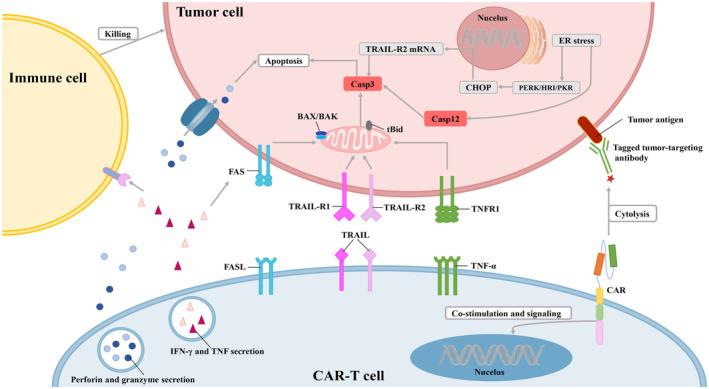
We explore various strategies to sensitize tumor cells to CAR-T-cell-mediated apoptosis, including the use of combination therapies with BH3 mimetics, Mcl-1 inhibitors, IAP inhibitors, and HDAC inhibitors. These agents inhibit anti-apoptotic proteins and activate intrinsic mitochondrial pathways, enhancing the susceptibility of tumor cells to apoptosis. Moreover, targeting the extrinsic pathway can increase the expression of death receptors on tumor cells, further promoting their apoptosis. The review also discusses the development of novel CAR constructs that enhance anti-apoptotic protein expression, such as Bcl-2, which may counteract CAR-T cell exhaustion and improve antitumor efficacy. We assess the impact of the tumor microenvironment (TME) on CAR-T cell function and propose dual-targeting CAR-T cells to simultaneously address both myeloid-derived suppressor cells (MDSCs) and tumor cells. Furthermore, we explore the potential of combining agents like PPAR inhibitors to activate the cGAS-STING pathway, thereby improving CAR-T cell infiltration into the tumor.
CONCLUSIONS
This review highlights that enhancing tumor cell sensitivity to apoptosis and increasing CAR-T cell cytotoxicity through apoptotic pathways could significantly improve therapeutic outcomes. Targeting apoptotic proteins, particularly those involved in the intrinsic mitochondrial pathway, constitutes a novel approach to overcoming resistance. The insights presented herein lay a robust foundation for future research and clinical applications aimed at optimizing CAR-T cell therapies.
背景
嵌合抗原受体 (CAR)-T 细胞疗法已经改变了癌症治疗方式,带来了显著的临床效果。然而,耐药性仍然是一个主要障碍,极大地限制了其在许多患者中的疗效。
目的
本综述批判性地考察了与 CAR-T 细胞疗法相关的挑战,特别关注凋亡途径在克服耐药性方面的作用。
方法
我们探讨了使肿瘤细胞对 CAR-T 细胞介导的细胞凋亡敏感的各种策略,包括使用 BH3 模拟物、Mcl-1 抑制剂、IAP 抑制剂和 HDAC 抑制剂的联合疗法。这些药物抑制抗凋亡蛋白并激活内在线粒体途径,增强肿瘤细胞对凋亡的敏感性。此外,靶向外在途径可以增加肿瘤细胞上死亡受体的表达,进一步促进其凋亡。该综述还讨论了开发新型 CAR 构建体的问题,这些构建体可以增强抗凋亡蛋白的表达,例如 Bcl-2,这可能会抵消 CAR-T 细胞衰竭并提高抗肿瘤疗效。我们评估了肿瘤微环境 (TME) 对 CAR-T 细胞功能的影响,并提出了双靶向 CAR-T 细胞,以同时针对髓样来源抑制细胞 (MDSC) 和肿瘤细胞。此外,我们探讨了联合使用 PPAR 抑制剂等药物激活 cGAS-STING 途径的潜力,从而提高 CAR-T 细胞在肿瘤中的浸润。
结论
本综述强调,通过凋亡途径增强肿瘤细胞对凋亡的敏感性并增加 CAR-T 细胞的细胞毒性,可以显著改善治疗效果。靶向凋亡蛋白,特别是那些涉及内在线粒体途径的蛋白,是克服耐药性的一种新方法。本文提出的观点为旨在优化 CAR-T 细胞疗法的未来研究和临床应用奠定了坚实的基础。


 Zotero 插件