
HDAC3:免疫治疗致敏中的多面调节因子
HDAC3: A Multifaceted Modulator in Immunotherapy Sensitization.
作者信息
Han Rui, Luo Yujun, Gao Jingdong, Zhou Huiling, Wang Yuqian, Chen Jiaojiao, Zheng Guoyin, Ling Changquan
机构信息
Oncology Department of Chinese Medicine, The First Affiliated Hospital of Naval Medical University, Shanghai 200433, China.
Department of Chinese Medicine, Naval Medical University, Shanghai 200433, China.
出版信息
Vaccines (Basel). 2025 Feb 13;13(2):182. doi: 10.3390/vaccines13020182.
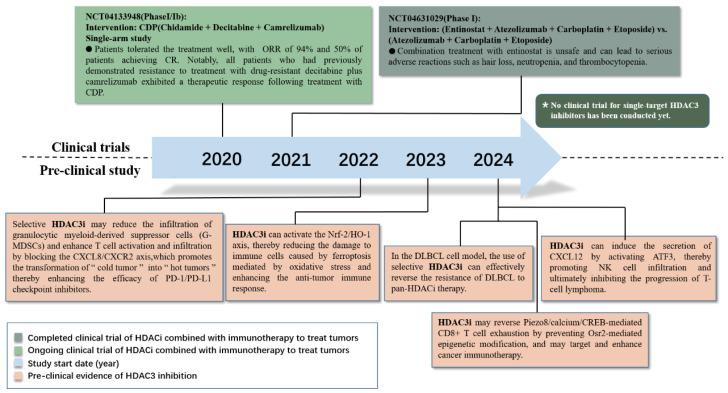
Histone deacetylase 3 (HDAC3) has emerged as a critical epigenetic regulator in tumor progression and immune modulation, positioning it as a promising target for enhancing cancer immunotherapy. This work comprehensively explores HDAC3's multifaceted roles, focusing on its regulation of key immune-modulatory pathways such as cGAS-STING, ferroptosis, and the Nrf2/HO-1 axis. These pathways are central to tumor immune evasion, antigen presentation, and immune cell activation. Additionally, the distinct effects of HDAC3 on various immune cell types-including its role in enhancing T cell activation, restoring NK cell cytotoxicity, promoting dendritic cell maturation, and modulating macrophage polarization-are thoroughly examined. These findings underscore HDAC3's capacity to reshape the tumor immune microenvironment, converting immunologically "cold tumors" into "hot tumors" and thereby increasing their responsiveness to immunotherapy. The therapeutic potential of HDAC3 inhibitors is highlighted, both as standalone agents and in combination with immune checkpoint inhibitors, to overcome resistance and improve treatment efficacy. Innovative strategies, such as the development of selective HDAC3 inhibitors, advanced nano-delivery systems, and integration with photodynamic or photothermal therapies, are proposed to enhance treatment precision and minimize toxicity. By addressing challenges such as toxicity, patient heterogeneity, and resistance mechanisms, this study provides a forward-looking perspective on the clinical application of HDAC3 inhibitors. It highlights its significant potential in personalized cancer immunotherapy, paving the way for more effective treatments and improved outcomes for cancer patients.
组蛋白去乙酰化酶3(HDAC3)已成为肿瘤进展和免疫调节中的关键表观遗传调节因子,使其成为增强癌症免疫治疗的一个有前景的靶点。这项工作全面探讨了HDAC3的多方面作用,重点关注其对关键免疫调节途径的调控,如cGAS-STING、铁死亡和Nrf2/HO-1轴。这些途径对于肿瘤免疫逃逸、抗原呈递和免疫细胞激活至关重要。此外,还深入研究了HDAC3对各种免疫细胞类型的不同影响,包括其在增强T细胞活化、恢复NK细胞细胞毒性、促进树突状细胞成熟和调节巨噬细胞极化中的作用。这些发现强调了HDAC3重塑肿瘤免疫微环境的能力,将免疫“冷肿瘤”转化为“热肿瘤”,从而提高其对免疫治疗的反应性。强调了HDAC3抑制剂作为单一药物以及与免疫检查点抑制剂联合使用以克服耐药性和提高治疗效果的治疗潜力。提出了创新策略,如开发选择性HDAC3抑制剂、先进的纳米递送系统以及与光动力或光热疗法相结合,以提高治疗精度并将毒性降至最低。通过应对毒性、患者异质性和耐药机制等挑战,本研究为HDAC3抑制剂的临床应用提供了前瞻性视角。它突出了其在个性化癌症免疫治疗中的巨大潜力,为癌症患者更有效的治疗和更好的预后铺平了道路。



 Zotero 插件