
噬菌体-抗生素联合疗法:方法学途径对疗效评估的影响
Phage-antibiotic combinations against : impact of methodological approaches on effect evaluation.
作者信息
Gorodnichev Roman B, Krivulia Anastasiia O, Kornienko Maria A, Abdraimova Narina K, Malakhova Maja V, Zaychikova Marina V, Bespiatykh Dmitry A, Manuvera Valentin A, Shitikov Egor A
机构信息
Department of Biomedicine and Genomics, Lopukhin Federal Research and Clinical Center of Physical-Chemical Medicine of Federal Medical Biological Agency, Moscow, Russia.
Moscow Center for Advanced Studies, Moscow, Russia.
出版信息
Front Microbiol. 2025 Mar 12;16:1530819. doi: 10.3389/fmicb.2025.1530819. eCollection 2025.
BACKGROUND
The combined use of bacteriophages and antibiotics represents a promising strategy for combating multidrug-resistant bacterial pathogens. However, the lack of uniformity in methods for assessing combination effects and experimental protocols has resulted in inconsistent findings across studies. This study aimed to evaluate the effects of interactions between phages and antibiotics on strains using various statistical approaches to formalize combination effects.
METHODS
Effects were assessed for four antibiotics from distinct classes (gentamicin, levofloxacin, meropenem, chloramphenicol), three phages from different genera (Dlv622, Seu621, FRZ284), and a depolymerase (Dep622) on three strains of the KL23 capsule type. Antibiotics were used at C concentrations, and phages at sublethal levels. A modified -test, Bliss independence model, two-way ANOVA, and checkerboard assay were employed to evaluate the results.
RESULTS
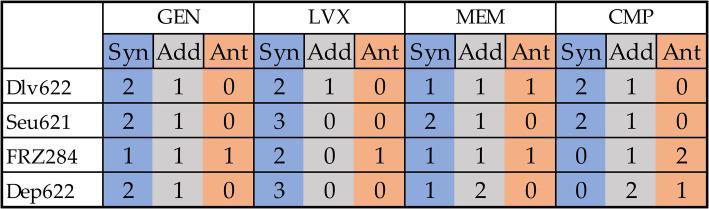
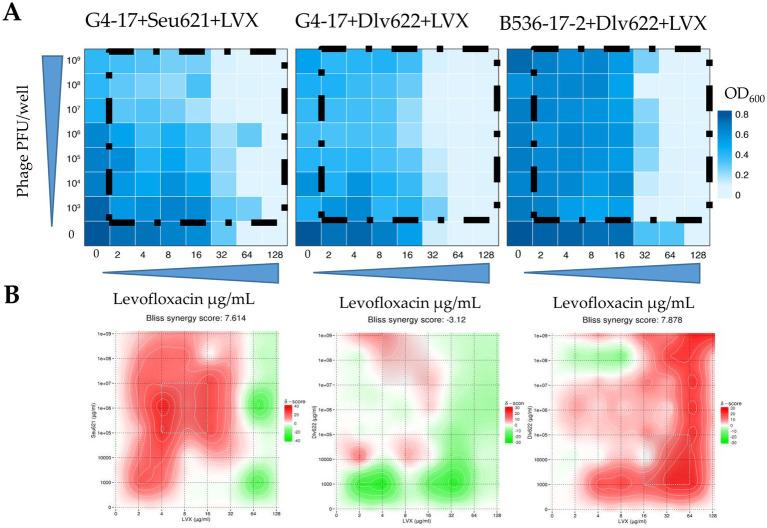
Among 48 combinations, 33 effects were statistically significant, including 26 cases of synergy and 7 of antagonism. All statistical methods showed consistency in identifying effects; however, the -test and Bliss method detected a greater number of effects. The strongest synergy was observed with levofloxacin in combination with Seu621 or Dep622 across all bacterial strains. Checkerboard assays confirmed synergy in selected cases but indicated that combined effects could vary with antimicrobial concentrations.
CONCLUSION
The choice of analytical method substantially impacts the detection of phage-antibiotic effects. The -test and Bliss method, due to their simplicity and sensitivity, may be optimal for clinical application, while two-way ANOVA for confirming strong interactions. These results emphasize the need to consider interaction characteristics when designing therapeutic strategies.
背景
噬菌体与抗生素联合使用是对抗多重耐药细菌病原体的一种有前景的策略。然而,评估联合效应的方法及实验方案缺乏一致性,导致各研究结果不一致。本研究旨在使用多种统计方法来规范联合效应,以评估噬菌体与抗生素之间的相互作用对菌株的影响。
方法
评估了来自不同类别的四种抗生素(庆大霉素、左氧氟沙星、美罗培南、氯霉素)、来自不同属的三种噬菌体(Dlv622、Seu621、FRZ284)以及一种解聚酶(Dep622)对三株KL23荚膜型菌株的影响。抗生素使用C浓度,噬菌体使用亚致死水平。采用改良的检验、布利斯独立性模型、双向方差分析和棋盘法评估结果。
结果
在48种组合中,33种效应具有统计学意义,其中协同作用26例,拮抗作用7例。所有统计方法在识别效应方面表现出一致性;然而,检验和布利斯方法检测到的效应数量更多。在所有细菌菌株中,观察到左氧氟沙星与Seu621或Dep622联合使用时协同作用最强。棋盘法在选定案例中证实了协同作用,但表明联合效应可能随抗菌药物浓度而变化。
结论
分析方法的选择对噬菌体 - 抗生素效应的检测有重大影响。检验和布利斯方法因其简单性和敏感性,可能最适合临床应用,而双向方差分析用于确认强相互作用。这些结果强调在设计治疗策略时需要考虑相互作用特征。


 Zotero 插件