
研究急性SARS-CoV-2感染期间SARS-CoV-2病毒血症与外周炎症在血小板功能障碍中的相互作用。
Investigating the Interplay of SARS-CoV-2 RNAemia and Peripheral Inflammation in Platelet Dysfunction During Acute SARS-CoV-2 Infection.
作者信息
Scavone Mariangela, Rovito Roberta, Ghali Claudia, Fioretti Antonella, Clerici Bianca, Bossi Elena, Tincati Camilla, Santoro Andrea, Borghi Elisa, Podda Gian Marco, Marchetti Giulia
机构信息
Division of General Medicine II, Department of Health Sciences, ASST Santi Paolo e Carlo, University of Milan, Milan, Italy.
Clinic of Infectious Diseases and Tropical Medicine, Department of Health Sciences, ASST Santi Paolo e Carlo, University of Milan, Italy.
出版信息
Pathog Immun. 2025 Jul 9;10(2):149-167. doi: 10.20411/pai.v10i2.823. eCollection 2025.
BACKGROUND
Circulating degranulated platelets have been described during acute SARS-CoV-2 infection and associated with COVID-19 complications. This study investigated the relationship between the presence of plasma SARS-CoV-2 RNA (ie, SARS-CoV-2 RNAemia), systemic inflammation, and platelet dysfunction in a group of patients with COVID-19. Unlike our previous publication, which focused on platelet characterization, this work explores potential determinants of platelet activation, based on a distinct subset of patients with available stored samples.
METHODS
Patients with COVID-19 were stratified by platelet δ-granule content using the luciferin/luciferase assay into 2 groups: normal (COV) and low (COV). Plasma SARS-CoV-2 RNAemia (RT-qPCR), cytokines, and chemokines (Cytometric Bead Array) were quantified on plasma samples. Markers of platelet activation were measured by flow cytometry in whole blood.
RESULTS
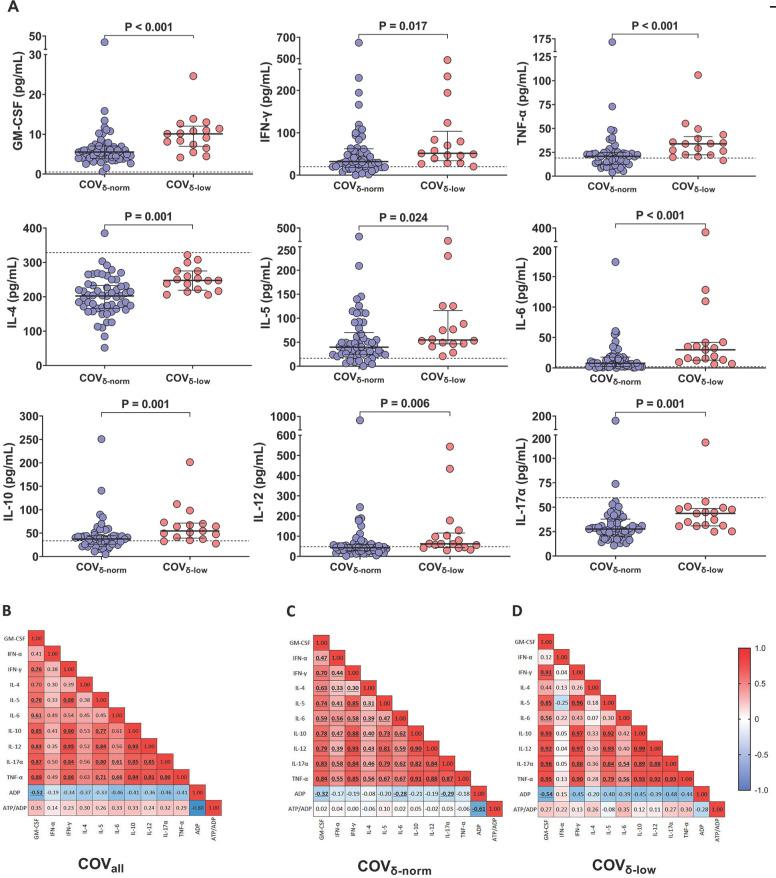
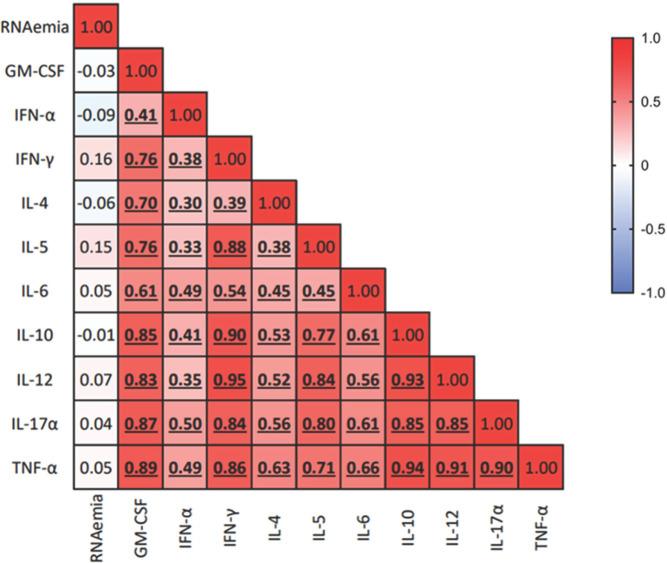
A total of 75 patients with COVID-19 were enrolled; 57 presented normal levels of platelet δ-granule content (COV) and 18 had low levels of platelet δ-granules (COV). Groups were comparable in terms of age, sex, comorbidities, and SARS-CoV-2 RNAemia levels. Patients in the COV group showed significantly higher chemokine and cytokine levels compared to those in the COV group, with strong correlations between IL-6, as well as granulocyte-macrophage colony-stimulating factor (GM-CSF), with platelet degranulation parameters. A similar trend, albeit less pronounced, was observed when patients were stratified based on their platelet activation phenotype.
CONCLUSIONS
These findings suggest that peripheral inflammation, rather than SARS-CoV-2 RNAemia, is associated with platelet dysfunction during acute SARS-CoV-2 infection.
背景
在急性严重急性呼吸综合征冠状病毒2(SARS-CoV-2)感染期间已发现循环中的脱颗粒血小板,且其与冠状病毒病2019(COVID-19)并发症相关。本研究调查了一组COVID-19患者血浆中SARS-CoV-2核糖核酸(即SARS-CoV-2病毒血症)、全身炎症与血小板功能障碍之间的关系。与我们之前专注于血小板特征描述的出版物不同,这项工作基于一组有可用储存样本的不同患者亚组,探索血小板活化的潜在决定因素。
方法
采用荧光素/荧光素酶测定法,根据血小板δ颗粒含量将COVID-19患者分为两组:正常组(COV)和低含量组(COV)。对血浆样本进行血浆SARS-CoV-2病毒血症(逆转录定量聚合酶链反应)、细胞因子和趋化因子(细胞计数珠阵列)的定量分析。通过全血流式细胞术检测血小板活化标志物。
结果
共纳入75例COVID-19患者;57例血小板δ颗粒含量正常(COV组),18例血小板δ颗粒含量低(COV组)。两组在年龄、性别、合并症和SARS-CoV-2病毒血症水平方面具有可比性。与COV组相比,COV组患者的趋化因子和细胞因子水平显著更高,白细胞介素-6以及粒细胞巨噬细胞集落刺激因子(GM-CSF)与血小板脱颗粒参数之间存在强相关性。当根据血小板活化表型对患者进行分层时,观察到类似趋势,尽管不太明显。
结论
这些发现表明,在急性SARS-CoV-2感染期间,外周炎症而非SARS-CoV-2病毒血症与血小板功能障碍相关。


 Zotero 插件