
组织代谢组学揭示了与动静脉内瘘狭窄内膜增生相关的代谢失调。
Tissue metabolomics reveals metabolic dysregulation associated with intimal hyperplasia in arteriovenous fistula stenosis.
作者信息
Zhao Ming, Wu Qixin, Zhao Yifei, Nian Rui, Li Wanjun, Lu Hongzhao
机构信息
Department of Nephrology, 3201 Hospital, Hanzhong, Shaanxi, China.
School of Biological Science and Engineering, Shaanxi University of Technology, Hanzhong, Shaanxi, China.
出版信息
Front Physiol. 2025 Aug 18;16:1638179. doi: 10.3389/fphys.2025.1638179. eCollection 2025.
OBJECTIVE
This study performed untargeted LC-MS metabolomics on venous tissues from maintenance hemodialysis patients undergoing arteriovenous fistula (AVF) reconstruction surgery.
METHODS
A total of six stenotic and six non-stenotic AVF tissues were analyzed. Paired samples were collected from stenotic AVF segments and non-stenotic regions (control group). Histological analysis revealed significant intimal hyperplasia in stenotic tissues (687.90 ± 149.00 μm vs. 286.70 ± 95.18 μm, P < 0.0001 by HE staining) and excessive collagen deposition (Masson staining).
RESULTS
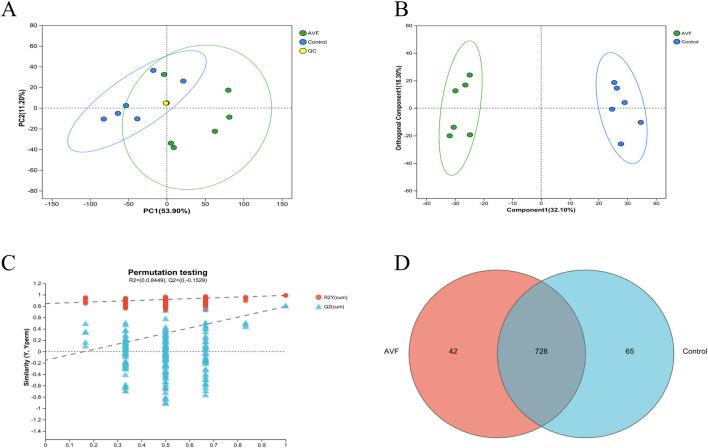
Metabolomic profiling identified 802 metabolites, with 356 differentially expressed (VIP > 1, P < 0.05), predominantly lipids/lipid-like molecules. KEGG enrichment highlighted five dysregulated pathways (P < 0.01): Arginine/proline metabolism; Glycerophospholipid metabolism; ABC transporters; Choline metabolism in cancer; Retrograde endocannabinoid signaling. Six metabolites showed perfect diagnostic potential (AUC = 1.0): niacin, free carnitine, 3-hydroxynonyl-5,7-dienoylcarnitine, 3-methylheptanediylcarnitine, dec-7-enoylcarnitine, and γ-aminobutyric acid. Significant metabolite-clinical correlations included: Choline positively correlating with serum phosphorus (r = 0.62, P = 0.008); Carnitine associating with hemoglobin levels (r = 0.58, P = 0.012).
CONCLUSION
This tissue-based metabolomics study defines specific metabolic disturbances driving AVF stenosis, proposing mechanistic insights and candidate biomarkers.
目的
本研究对接受动静脉内瘘(AVF)重建手术的维持性血液透析患者的静脉组织进行了非靶向液相色谱-质谱代谢组学分析。
方法
共分析了6个狭窄的和6个非狭窄的AVF组织。从狭窄的AVF节段和非狭窄区域(对照组)采集配对样本。组织学分析显示狭窄组织存在明显的内膜增生(苏木精-伊红染色,687.90±149.00μm vs. 286.70±95.18μm,P<0.0001)和过多的胶原沉积(Masson染色)。
结果
代谢组学分析鉴定出802种代谢物,其中356种差异表达(VIP>1,P<0.05),主要为脂质/类脂质分子。京都基因与基因组百科全书(KEGG)富集分析突出了5条失调的通路(P<0.01):精氨酸/脯氨酸代谢;甘油磷脂代谢;ABC转运蛋白;癌症中的胆碱代谢;逆行性内源性大麻素信号传导。6种代谢物显示出完美的诊断潜力(曲线下面积[AUC]=1.0):烟酸、游离肉碱、3-羟基壬基-5,7-二烯酰肉碱、3-甲基庚二酰肉碱、癸-7-烯酰肉碱和γ-氨基丁酸。显著的代谢物-临床相关性包括:胆碱与血清磷呈正相关(r=0.62,P=0.008);肉碱与血红蛋白水平相关(r=0.58,P=0.012)。
结论
这项基于组织的代谢组学研究确定了导致AVF狭窄的特定代谢紊乱,提出了机制见解和候选生物标志物。




 Zotero 插件