
表面感应的异质性表明群体内存在分工。
Heterogeneity in surface sensing suggests a division of labor in populations.
机构信息
Department of Microbiology, University of Washington, Seattle, United States.
Department of Bioengineering, University of California, Los Angeles, Los Angeles, United States.
出版信息
Elife. 2019 Jun 10;8:e45084. doi: 10.7554/eLife.45084.
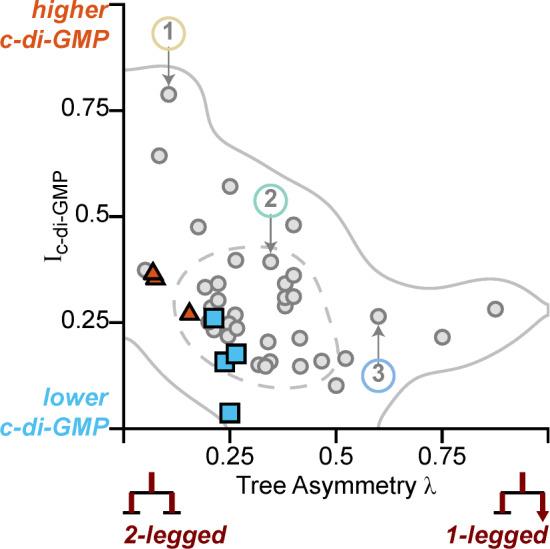
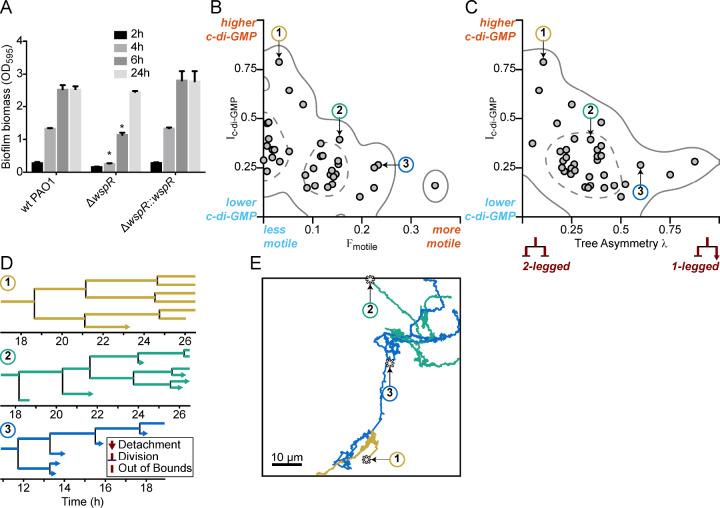
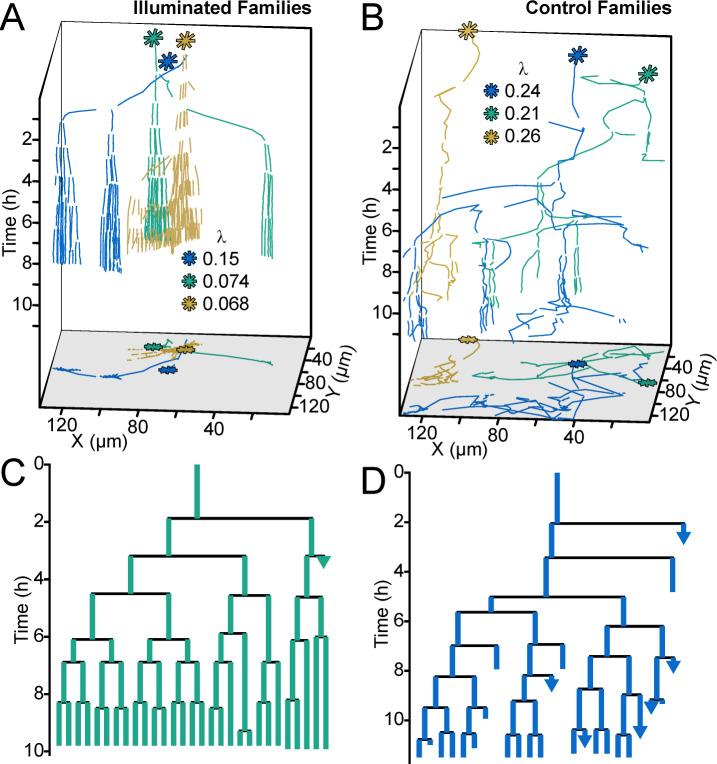
The second messenger signaling molecule cyclic diguanylate monophosphate (c-di-GMP) drives the transition between planktonic and biofilm growth in many bacterial species. has two surface sensing systems that produce c-di-GMP in response to surface adherence. Current thinking in the field is that once cells attach to a surface, they uniformly respond by producing c-di-GMP. Here, we describe how the Wsp system generates heterogeneity in surface sensing, resulting in two physiologically distinct subpopulations of cells. One subpopulation has elevated c-di-GMP and produces biofilm matrix, serving as the founders of initial microcolonies. The other subpopulation has low c-di-GMP and engages in surface motility, allowing for exploration of the surface. We also show that this heterogeneity strongly correlates to surface behavior for descendent cells. Together, our results suggest that after surface attachment, engages in a division of labor that persists across generations, accelerating early biofilm formation and surface exploration.
双信使信号分子环二鸟苷酸单磷酸(c-di-GMP)驱动许多细菌物种从浮游生长到生物膜生长的转变。 有两个表面感应系统,可响应表面附着产生 c-di-GMP。目前该领域的主流观点认为,一旦细胞附着在表面上,它们就会通过产生 c-di-GMP 做出一致的反应。在这里,我们描述了 Wsp 系统如何产生表面感应的异质性,从而导致细胞形成两种生理上不同的亚群。一个亚群的 c-di-GMP 水平升高并产生生物膜基质,充当初始微菌落的创始人。另一个亚群的 c-di-GMP 水平较低,参与表面运动,从而可以探索表面。我们还表明,这种异质性与后代细胞的表面行为强烈相关。总之,我们的研究结果表明,表面附着后, 进行了一种跨代持续的分工,从而加速了早期生物膜的形成和表面探索。








 Zotero 插件