
CD122 定向白细胞介素-2 治疗膀胱癌的机制不同于 αPD-L1,包括组织选择性 γδ T 细胞激活。
CD122-directed interleukin-2 treatment mechanisms in bladder cancer differ from αPD-L1 and include tissue-selective γδ T cell activation.
机构信息
South Texas Medical Scientist Training Program, University of Texas Health San Antonio, San Antonio, Texas, USA.
Mays Cancer Center, University of Texas Health San Antonio, San Antonio, Texas, USA.
出版信息
J Immunother Cancer. 2021 Apr;9(4). doi: 10.1136/jitc-2020-002051.
BACKGROUND
Anti-programmed death-ligand 1 (αPD-L1) immunotherapy is approved to treat bladder cancer (BC) but is effective in <30% of patients. Interleukin (IL)-2/αIL-2 complexes (IL-2c) that preferentially target IL-2 receptor β (CD122) augment CD8 antitumor T cells known to improve αPD-L1 efficacy. We hypothesized that the tumor microenvironment, including local immune cells in primary versus metastatic BC, differentially affects immunotherapy responses and that IL-2c effects could differ from, and thus complement αPD-L1.
METHODS
We studied mechanisms of IL-2c and αPD-L1 efficacy using PD-L1 mouse BC cell lines MB49 and MBT-2 in orthotopic (bladder) and metastatic (lung) sites.
RESULTS
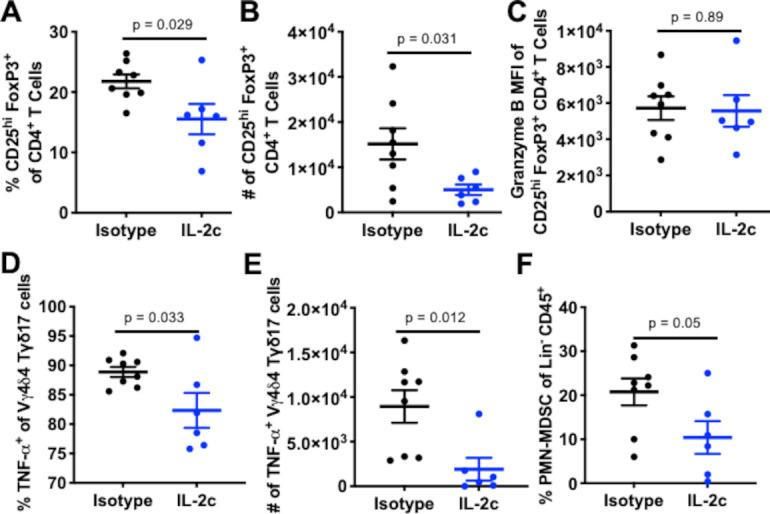
IL-2c reduced orthotopic tumor burden and extended survival in MB49 and MBT-2 BC models, similar to αPD-L1. Using antibody-mediated cell depletions and genetically T cell-deficient mice, we unexpectedly found that CD8 T cells were not necessary for IL-2c efficacy against tumors in bladder, whereas γδ T cells, not reported to contribute to αPD-L1 efficacy, were indispensable for IL-2c efficacy there. αPD-L1 responsiveness in bladder required conventional T cells as expected, but not γδ T cells, altogether defining distinct mechanisms for IL-2c and αPD-L1 efficacy. γδ T cells did not improve IL-2c treatment of subcutaneously challenged BC or orthotopic (peritoneal) ovarian cancer, consistent with tissue-specific and/or tumor-specific γδ T cell contributions to IL-2c efficacy. IL-2c significantly altered bladder intratumoral γδ T cell content, activation status, and specific γδ T cell subsets with antitumor or protumor effector functions. Neither IL-2c nor αPD-L1 alone treated lung metastatic MB49 or MBT-2 BC, but their combination improved survival in both models. Combination treatment efficacy in lungs required CD8 T cells but not γδ T cells.
CONCLUSIONS
Mechanistic insights into differential IL-2c and αPD-L1 treatment and tissue-dependent effects could help develop rational combination treatment strategies to improve treatment efficacy in distinct cancers. These studies also provide insights into γδ T cell contributions to immunotherapy in bladder and engagement of adaptive immunity by IL-2c plus αPD-L1 to treat refractory lung metastases.
背景
抗程序性死亡配体 1(αPD-L1)免疫疗法已被批准用于治疗膀胱癌(BC),但仅对<30%的患者有效。白细胞介素(IL)-2/αIL-2 复合物(IL-2c)优先靶向 IL-2 受体 β(CD122),增强已知可提高 αPD-L1 疗效的 CD8 抗肿瘤 T 细胞。我们假设肿瘤微环境,包括原发性和转移性 BC 中的局部免疫细胞,会对免疫治疗反应产生不同的影响,并且 IL-2c 的作用可能与 αPD-L1 不同,从而互补。
方法
我们使用 PD-L1 小鼠 BC 细胞系 MB49 和 MBT-2 在原位(膀胱)和转移性(肺)部位研究了 IL-2c 和 αPD-L1 疗效的机制。
结果
IL-2c 减少了 MB49 和 MBT-2 BC 模型的原位肿瘤负担并延长了生存时间,与 αPD-L1 相似。通过抗体介导的细胞耗竭和基因敲除的 T 细胞缺陷小鼠,我们出乎意料地发现 CD8 T 细胞不是 IL-2c 治疗膀胱肿瘤所必需的,而 γδ T 细胞,据报道与 αPD-L1 疗效无关,对于 IL-2c 在那里的疗效是必不可少的。如预期的那样,αPD-L1 对膀胱的反应性需要常规 T 细胞,但不需要 γδ T 细胞,这共同定义了 IL-2c 和 αPD-L1 疗效的不同机制。γδ T 细胞没有改善 IL-2c 治疗皮下挑战的 BC 或原位(腹膜)卵巢癌,这与 γδ T 细胞对 IL-2c 疗效的组织特异性和/或肿瘤特异性贡献一致。IL-2c 显著改变了膀胱肿瘤内 γδ T 细胞的含量、激活状态和具有抗肿瘤或促肿瘤效应功能的特定 γδ T 细胞亚群。IL-2c 或 αPD-L1 单独治疗肺转移性 MB49 或 MBT-2 BC 均未治疗,但两者联合治疗可改善两种模型的生存率。联合治疗在肺部的疗效需要 CD8 T 细胞,但不需要 γδ T 细胞。
结论
对 IL-2c 和 αPD-L1 治疗的差异和组织依赖性影响的机制见解有助于制定合理的联合治疗策略,以提高不同癌症的治疗效果。这些研究还提供了对膀胱中 γδ T 细胞对免疫治疗的贡献以及 IL-2c 加 αPD-L1 对治疗难治性肺转移的适应性免疫的见解。


 Zotero 插件