
SARS-CoV-2 刺突蛋白的蛋白水解激活。
Proteolytic activation of SARS-CoV-2 spike protein.
机构信息
Department of Virology 3, National Institute of Infectious Diseases, Tokyo, Japan.
出版信息
Microbiol Immunol. 2022 Jan;66(1):15-23. doi: 10.1111/1348-0421.12945. Epub 2021 Oct 12.
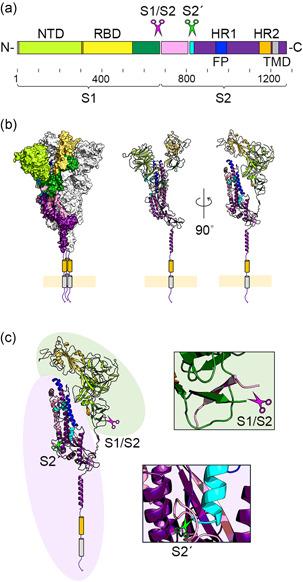
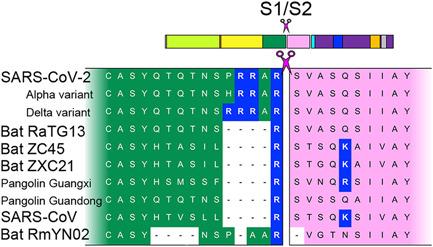
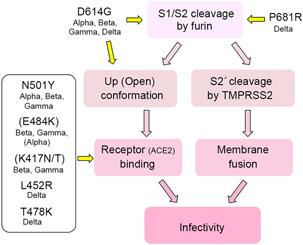
Spike (S) protein cleavage is a crucial step in coronavirus infection. In this review, this process is discussed, with particular focus on the novel coronavirus, severe acute respiratory syndrome coronavirus 2 (SARS-CoV-2). Compared with influenza virus and paramyxovirus membrane fusion proteins, the cleavage activation mechanism of coronavirus S protein is much more complex. The S protein has two cleavage sites (S1/S2 and S2'), and the cleavage motif for furin protease at the S1/S2 site that results from a unique four-amino acid insertion is one of the distinguishing features of SARS-CoV-2. The viral particle incorporates the S protein, which has already undergone S1/S2 cleavage by furin, and then undergoes further cleavage at the S2' site, mediated by the type II transmembrane serine protease transmembrane protease serine 2 (TMPRSS2), after binding to the receptor angiotensin-converting enzyme 2 (ACE2) to facilitate membrane fusion at the plasma membrane. In addition, SARS-CoV-2 can enter the cell by endocytosis and be proteolytically activated by cathepsin L, although this is not a major mode of SARS-CoV-2 infection. SARS-CoV-2 variants with enhanced infectivity have been emerging throughout the ongoing pandemic, and there is a close relationship between enhanced infectivity and changes in S protein cleavability. All four variants of concern carry the D614G mutation, which indirectly enhances S1/S2 cleavability by furin. The P681R mutation of the delta variant directly increases S1/S2 cleavability, enhancing membrane fusion and SARS-CoV-2 virulence. Changes in S protein cleavability can significantly impact viral infectivity, tissue tropism, and virulence. Understanding these mechanisms is critical to counteracting the coronavirus pandemic.
刺突(S)蛋白裂解是冠状病毒感染的关键步骤。在这篇综述中,讨论了这一过程,特别关注新型冠状病毒,严重急性呼吸综合征冠状病毒 2(SARS-CoV-2)。与流感病毒和副粘病毒膜融合蛋白相比,冠状病毒 S 蛋白的裂解激活机制要复杂得多。S 蛋白有两个裂解位点(S1/S2 和 S2'),S1/S2 位点上的furin 蛋白酶裂解激活基序是 SARS-CoV-2 的特征之一,该基序是由独特的四氨基酸插入形成的。病毒颗粒包含已经被 furin 进行了 S1/S2 裂解的 S 蛋白,然后在与受体血管紧张素转换酶 2(ACE2)结合后,通过 II 型跨膜丝氨酸蛋白酶跨膜丝氨酸蛋白酶 2(TMPRSS2)介导,在质膜上进一步进行 S2'位点的裂解,从而促进膜融合。此外,SARS-CoV-2 可以通过内吞作用进入细胞,并被组织蛋白酶 L 进行蛋白水解激活,尽管这不是 SARS-CoV-2 感染的主要方式。在持续的大流行中,具有增强感染力的 SARS-CoV-2 变体不断出现,并且增强的感染力与 S 蛋白可裂解性的变化密切相关。所有四种关注的变体都携带 D614G 突变,该突变通过 furin 间接增强了 S1/S2 的可裂解性。德尔塔变体的 P681R 突变直接增加了 S1/S2 的可裂解性,增强了膜融合和 SARS-CoV-2 的毒力。S 蛋白可裂解性的变化会显著影响病毒的感染力、组织嗜性和毒力。了解这些机制对于对抗冠状病毒大流行至关重要。




 Zotero 插件