
Dpp4+ 间质祖细胞有助于基础和高脂肪饮食诱导的脂肪生成。
Dpp4+ interstitial progenitor cells contribute to basal and high fat diet-induced adipogenesis.
机构信息
Institute for Diabetes, Obesity and Metabolism, Perelman School of Medicine at the University of Pennsylvania, Philadelphia, PA 19104, USA; Department of Medicine, Division of Endocrinology, Perelman School of Medicine at the University of Pennsylvania, Philadelphia, PA 19104, USA.
Institute for Diabetes, Obesity and Metabolism, Perelman School of Medicine at the University of Pennsylvania, Philadelphia, PA 19104, USA.
出版信息
Mol Metab. 2021 Dec;54:101357. doi: 10.1016/j.molmet.2021.101357. Epub 2021 Oct 15.
OBJECTIVE
The capacity to generate new adipocytes from precursor cells is critical for maintaining metabolic health. Adipocyte precursor cells (APCs) constitute a heterogenous collection of cell types; however, the contribution of these various cell types to adipose tissue expansion in vivo remains unknown. The aim of the current study is to investigate the contribution of Dpp4+ progenitors to de novo adipogenesis.
METHODS
Single cell analysis has identified several transcriptionally distinct subpopulations of APCs, including Dpp4+ progenitor cells concentrated in the connective tissue surrounding many organs, including white adipose tissue (WAT). Here, we generated a Dpp4 mouse model for in vivo lineage tracing of these cells and their downstream progeny in the setting of basal or high fat diet (HFD)-stimulated adipogenesis.
RESULTS
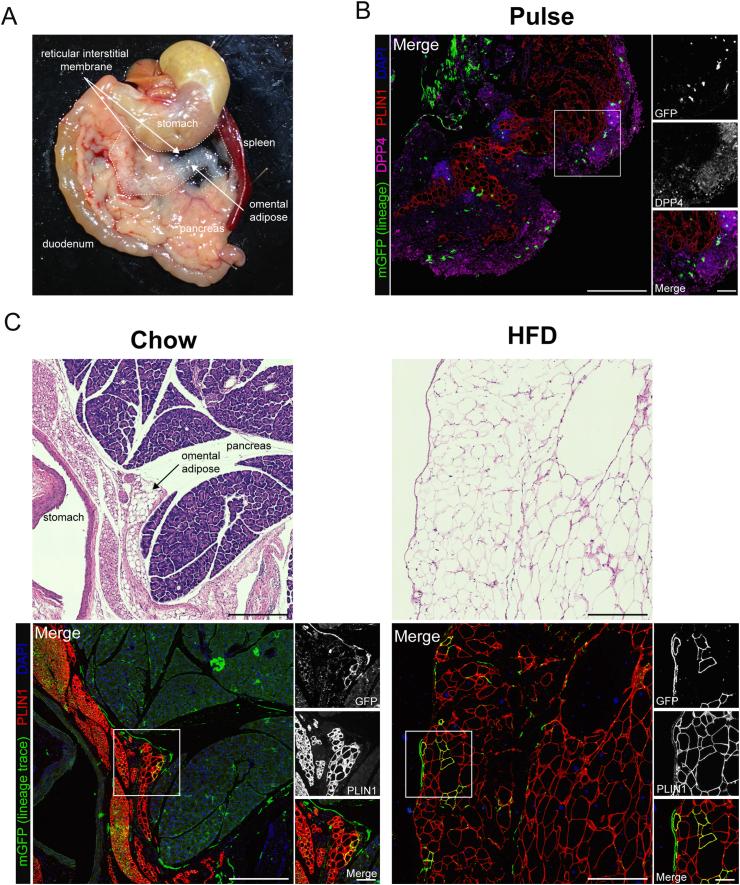
Dpp4 mice enabled specific temporal labeling of Dpp4+ progenitor cells within their native connective tissue niche. Following a dietary chase period consisting of chow or HFD feeding for 18 weeks, Dpp4+ progenitors differentiated into mature adipocytes within the gonadal and subcutaneous WAT. HFD stimulated adipogenic contribution from Dpp4+ cells in the gonadal but not the subcutaneous depot. Flow cytometry analysis revealed that Dpp4+ progenitors give rise to DPP4(-)/ICAM1+ preadipocytes in vivo. HFD feeding did not perturb the flux of Dpp4+ cell conversion into ICAM1+ preadipocytes in gonadal WAT. Conversely, in subcutaneous WAT, HFD feeding/obesity led to an accumulation of ICAM1+ preadipocytes without a corresponding increase in mature adipocyte differentiation. Examination of non-classical murine visceral depots with relevance to humans, including omentum and retroperitoneal WAT, revealed robust contribution of Dpp4+ progenitors to de novo adipogenesis, which was further stimulated by HFD.
CONCLUSION
Our data demonstrate that Dpp4+ interstitial progenitor cells contribute to basal adipogenesis in all fat depots and are recruited to support de novo adipogenic expansion of visceral WAT in the setting of HFD-induced obesity.
目的
前体细胞生成新脂肪细胞的能力对于维持代谢健康至关重要。脂肪细胞前体细胞(APCs)是一个异质的细胞类型集合;然而,这些不同细胞类型对体内脂肪组织扩张的贡献尚不清楚。本研究旨在研究 Dpp4+祖细胞对新脂肪生成的贡献。
方法
单细胞分析已经确定了几个转录上不同的 APC 亚群,包括 Dpp4+祖细胞,集中在许多器官的结缔组织中,包括白色脂肪组织(WAT)。在这里,我们生成了 Dpp4 小鼠模型,用于在基础或高脂肪饮食(HFD)刺激脂肪生成的情况下,对这些细胞及其下游祖细胞进行体内谱系追踪。
结果
Dpp4 小鼠能够在其天然结缔组织龛位中特异性地标记 Dpp4+祖细胞。在包括 18 周的 chow 或 HFD 喂养的饮食追踪期之后,Dpp4+祖细胞在性腺和皮下 WAT 中分化为成熟脂肪细胞。HFD 刺激了性腺中 Dpp4+细胞的脂肪生成贡献,但不是皮下脂肪垫。流式细胞术分析显示,Dpp4+祖细胞在体内产生 DPP4(-)/ICAM1+前脂肪细胞。HFD 喂养不会干扰 Dpp4+细胞转化为性腺 WAT 中 ICAM1+前脂肪细胞的通量。相反,在皮下 WAT 中,HFD 喂养/肥胖导致 ICAM1+前脂肪细胞的积累,而没有相应增加成熟脂肪细胞分化。对与人类相关的非经典鼠类内脏脂肪组织(包括网膜和腹膜后 WAT)的检查显示,Dpp4+间质祖细胞对所有脂肪组织的基础脂肪生成有很大贡献,并且在 HFD 诱导的肥胖中被募集来支持内脏 WAT 的新脂肪生成扩张。
结论
我们的数据表明,Dpp4+间质祖细胞有助于所有脂肪组织的基础脂肪生成,并且在 HFD 诱导的肥胖中被募集来支持内脏 WAT 的新脂肪生成扩张。




 Zotero 插件