
地西他滨对膀胱癌细胞的表观遗传引发作用增强了人 EGFR 和 CD44v6 CAR 工程化 T 细胞的细胞毒性。
Epigenetic Priming of Bladder Cancer Cells With Decitabine Increases Cytotoxicity of Human EGFR and CD44v6 CAR Engineered T-Cells.
机构信息
Department of Urology, Medical Faculty, Heinrich Heine University Duesseldorf, Duesseldorf, Germany.
Department of Otorhinolaryngology and Head and Neck Surgery, Medical Faculty, Heinrich Heine University Duesseldorf, Duesseldorf, Germany.
出版信息
Front Immunol. 2021 Nov 17;12:782448. doi: 10.3389/fimmu.2021.782448. eCollection 2021.
BACKGROUND
Treatment of B-cell malignancies with CD19-directed chimeric antigen receptor (CAR) T-cells marked a new era in immunotherapy, which yet has to be successfully adopted to solid cancers. Epigenetic inhibitors of DNA methyltransferases (DNMTi) and histone deacetylases (HDACi) can induce broad changes in gene expression of malignant cells, thus making these inhibitors interesting combination partners for immunotherapeutic approaches.
METHODS
Urothelial carcinoma cell lines (UCC) and benign uroepithelial HBLAK cells pretreated with the DNMTi decitabine or the HDACi romidepsin were co-incubated with CAR T-cells directed against EGFR or CD44v6, and subsequent cytotoxicity assays were performed. Effects on T-cell cytotoxicity and surface antigen expression on UCC were determined by flow cytometry. We also performed next-generation mRNA sequencing of inhibitor-treated UCC and siRNA-mediated knockdown of potential regulators of CAR T-cell killing.
RESULTS
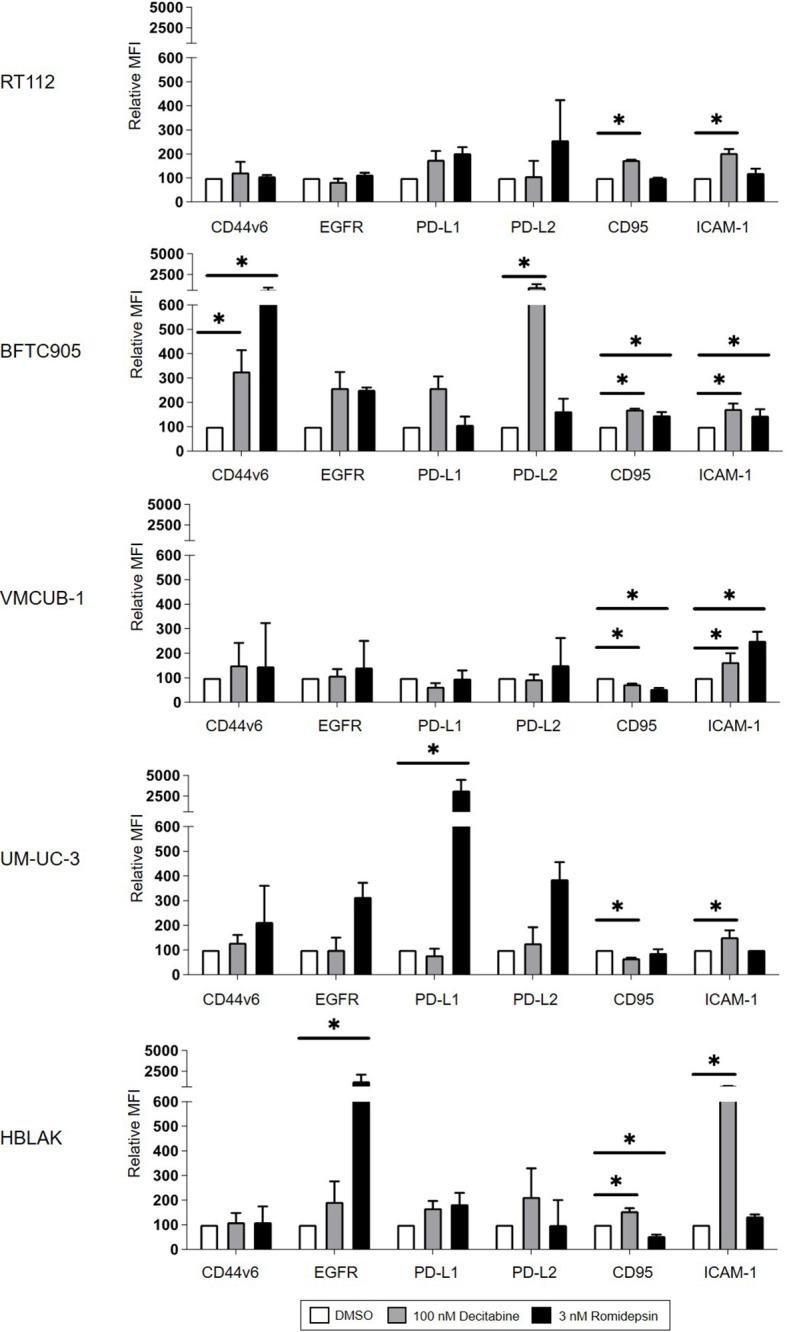
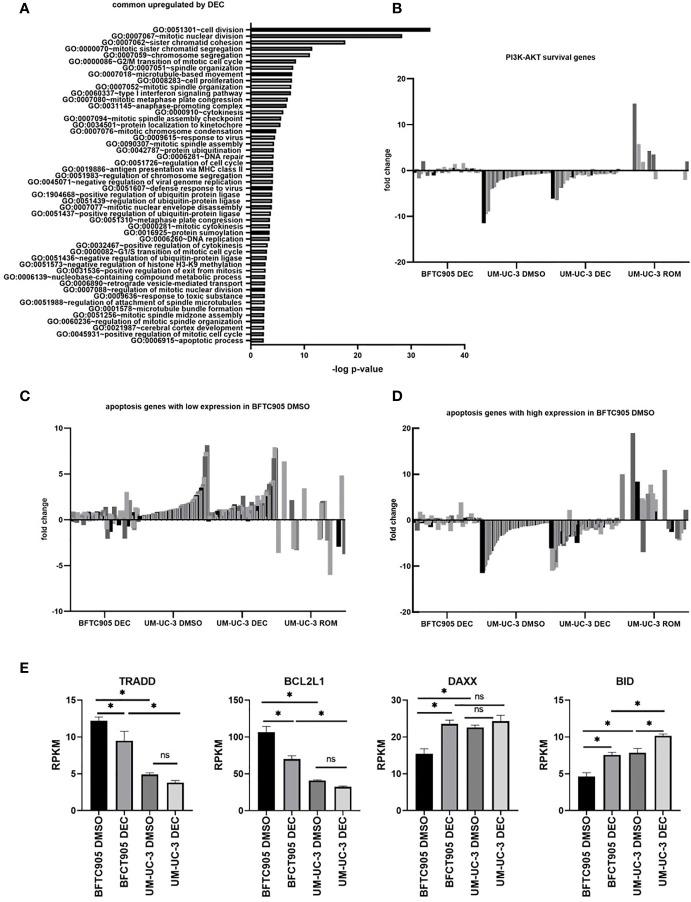
Exposure to decitabine but not romidepsin enhanced CAR T-cell cytotoxicity towards all UCC lines, but not towards the benign HBLAK cells. Increased killing could neither be attributed to enhanced target antigen expression (EGFR and CD44v6) nor fully explained by changes in the T-cell ligands PD-L1, PD-L2, ICAM-1, or CD95. Instead, gene expression analysis suggested that regulators of cell survival and apoptosis were differentially induced by the treatment. Decitabine altered the balance between survival and apoptosis factors towards an apoptosis-sensitive state associated with increased CAR T-cell killing, while romidepsin, at least partially, tilted this balance in the opposite direction. Knockdown experiments with siRNA in UCC confirmed BID and BCL2L1/BCLX as two key factors for the altered susceptibility of the UCC.
CONCLUSION
Our data suggest that the combination of decitabine with CAR T-cell therapy is an attractive novel therapeutic approach to enhance tumor-specific killing of bladder cancer. Since BID and BCL2L1 are essential determinants for the susceptibility of a wide variety of malignant cells, their targeting might be additionally suitable for combination with immunotherapies, e.g., CAR T-cells or checkpoint inhibitors in other malignancies.
背景
嵌合抗原受体 (CAR) T 细胞靶向 B 细胞恶性肿瘤的治疗标志着免疫治疗的新时代,然而,这一治疗方法尚未成功应用于实体瘤。DNA 甲基转移酶 (DNMTi) 和组蛋白去乙酰化酶 (HDACi) 的表观遗传抑制剂可以诱导恶性细胞中广泛的基因表达变化,因此这些抑制剂成为免疫治疗方法的有趣联合治疗伙伴。
方法
用 DNMTi 地西他滨或 HDACi 罗米地辛预处理的尿路上皮癌细胞系 (UCC) 和良性尿上皮 HBLAK 细胞与针对 EGFR 或 CD44v6 的 CAR T 细胞共孵育,随后进行细胞毒性测定。通过流式细胞术确定 UCC 上对 T 细胞细胞毒性和表面抗原表达的影响。我们还对抑制剂处理的 UCC 进行了下一代 mRNA 测序,并通过 siRNA 介导的 CAR T 细胞杀伤的潜在调节剂进行了敲低。
结果
与 romidepsin 相比,地西他滨暴露增强了针对所有 UCC 系的 CAR T 细胞的细胞毒性,但对良性 HBLAK 细胞没有增强作用。增加的杀伤既不能归因于靶抗原表达(EGFR 和 CD44v6)的增强,也不能完全用 T 细胞配体 PD-L1、PD-L2、ICAM-1 或 CD95 的变化来解释。相反,基因表达分析表明,细胞存活和凋亡调节剂的差异诱导。地西他滨改变了生存和凋亡因子之间的平衡,使其朝着与 CAR T 细胞杀伤增加相关的凋亡敏感状态倾斜,而 romidepsin 至少部分地使这种平衡向相反的方向倾斜。UCC 中的 siRNA 敲低实验证实 BID 和 BCL2L1/BCLX 是 UCC 易感性改变的两个关键因素。
结论
我们的数据表明,地西他滨与 CAR T 细胞治疗的联合是增强膀胱癌肿瘤特异性杀伤的一种有吸引力的新治疗方法。由于 BID 和 BCL2L1 是多种恶性细胞易感性的重要决定因素,因此它们的靶向可能还适合与免疫治疗相结合,例如在其他恶性肿瘤中与 CAR T 细胞或检查点抑制剂相结合。


 Zotero 插件