
高通量多参数筛选用于加速可溶性遗传编码荧光生物传感器的开发和优化。
A high-throughput multiparameter screen for accelerated development and optimization of soluble genetically encoded fluorescent biosensors.
机构信息
Department of Neurobiology, Harvard Medical School, Boston, MA, USA.
Department of Biology, Massachusetts Institute of Technology, Cambridge, MA, USA.
出版信息
Nat Commun. 2022 May 25;13(1):2919. doi: 10.1038/s41467-022-30685-x.
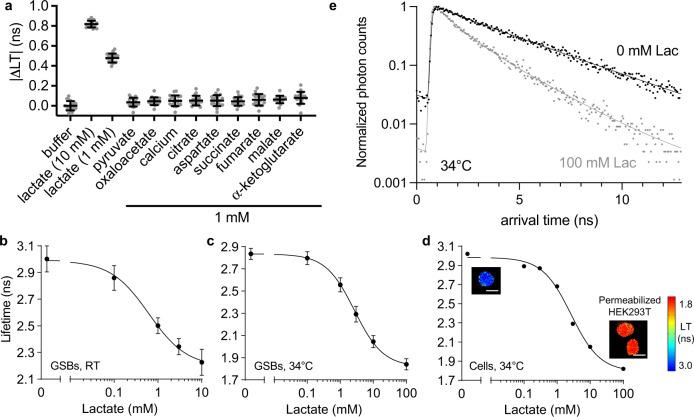
Genetically encoded fluorescent biosensors are powerful tools used to track chemical processes in intact biological systems. However, the development and optimization of biosensors remains a challenging and labor-intensive process, primarily due to technical limitations of methods for screening candidate biosensors. Here we describe a screening modality that combines droplet microfluidics and automated fluorescence imaging to provide an order of magnitude increase in screening throughput. Moreover, unlike current techniques that are limited to screening for a single biosensor feature at a time (e.g. brightness), our method enables evaluation of multiple features (e.g. contrast, affinity, specificity) in parallel. Because biosensor features can covary, this capability is essential for rapid optimization. We use this system to generate a high-performance biosensor for lactate that can be used to quantify intracellular lactate concentrations. This biosensor, named LiLac, constitutes a significant advance in metabolite sensing and demonstrates the power of our screening approach.
基因编码荧光生物传感器是用于跟踪完整生物系统中化学过程的强大工具。然而,生物传感器的开发和优化仍然是一个具有挑战性和劳动密集型的过程,主要是由于筛选候选生物传感器的方法存在技术限制。在这里,我们描述了一种筛选模式,该模式结合了液滴微流控和自动化荧光成像,可将筛选通量提高一个数量级。此外,与目前一次只能筛选单个生物传感器特征(例如亮度)的技术不同,我们的方法可以同时评估多个特征(例如对比度、亲和力、特异性)。由于生物传感器特征可能会相互影响,因此这种能力对于快速优化至关重要。我们使用该系统生成了一种用于乳酸的高性能生物传感器,可用于定量细胞内乳酸浓度。这种生物传感器名为 LiLac,它是代谢物传感领域的重大进展,展示了我们筛选方法的强大功能。


 Zotero 插件