
治疗耐多药金黄色葡萄球菌感染的新型抗菌策略。
Novel antimicrobial strategies to treat multi-drug resistant Staphylococcus aureus infections.
机构信息
Department of Life Sciences, University of Bath, Bath, UK.
出版信息
Microb Biotechnol. 2023 Jul;16(7):1456-1474. doi: 10.1111/1751-7915.14268. Epub 2023 May 13.
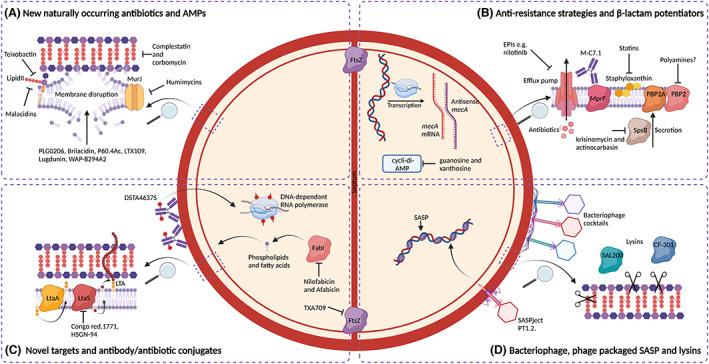
Antimicrobial resistance is a major obstacle for the treatment of infectious diseases and currently represents one of the most significant threats to global health. Staphylococcus aureus remains a formidable human pathogen with high mortality rates associated with severe systemic infections. S. aureus has become notorious as a multidrug resistant bacterium, which when combined with its extensive arsenal of virulence factors that exacerbate disease, culminates in an incredibly challenging pathogen to treat clinically. Compounding this major health issue is the lack of antibiotic discovery and development, with only two new classes of antibiotics approved for clinical use in the last 20 years. Combined efforts from the scientific community have reacted to the threat of dwindling treatment options to combat S. aureus disease in several innovative and exciting developments. This review describes current and future antimicrobial strategies aimed at treating staphylococcal colonization and/or disease, examining therapies that show significant promise at the preclinical development stage to approaches that are currently being investigated in clinical trials.
抗菌药物耐药性是治疗传染病的主要障碍,目前是对全球健康的最大威胁之一。金黄色葡萄球菌仍然是一种强大的人类病原体,严重的全身感染与之相关的死亡率很高。金黄色葡萄球菌已成为众所周知的多药耐药细菌,其结合其广泛的毒力因子,加剧疾病,最终导致一种非常具有挑战性的临床治疗病原体。使这个主要的健康问题更加复杂的是抗生素的发现和开发的缺乏,在过去 20 年中,只有两种新的抗生素类别被批准用于临床使用。科学界的共同努力对治疗金黄色葡萄球菌疾病的治疗选择日益减少的威胁做出了反应,在几个创新和令人兴奋的发展中。本综述描述了目前和未来旨在治疗葡萄球菌定植和/或疾病的抗菌策略,检查了在临床前开发阶段显示出显著前景的治疗方法,以及目前正在临床试验中研究的方法。

 Zotero 插件