
KDM6A-SND1 相互作用通过保护新生 DNA 来维持基因组稳定性,并有助于癌症的化疗耐药性。
KDM6A-SND1 interaction maintains genomic stability by protecting the nascent DNA and contributes to cancer chemoresistance.
机构信息
Department of Biotherapy, Cancer Center and State Key Laboratory of Biotherapy, Frontiers Science Center for Disease-related Molecular Network, West China Hospital, Sichuan University, Chengdu 610041, China.
出版信息
Nucleic Acids Res. 2024 Jul 22;52(13):7665-7686. doi: 10.1093/nar/gkae487.
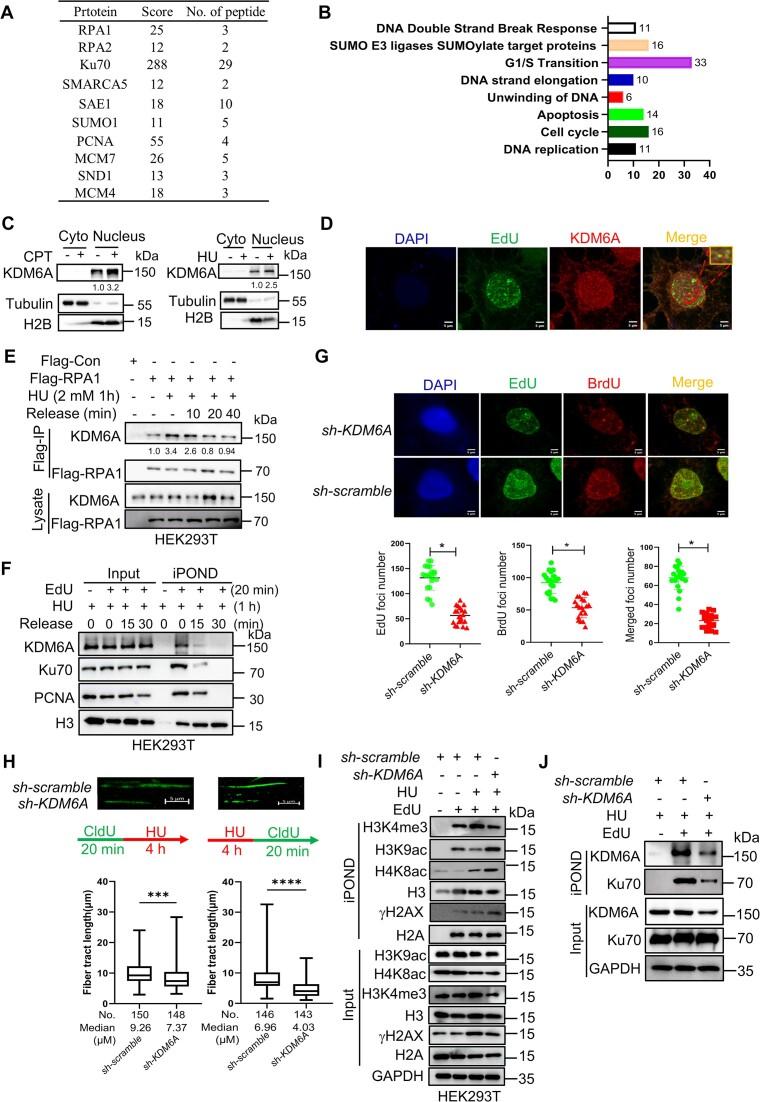
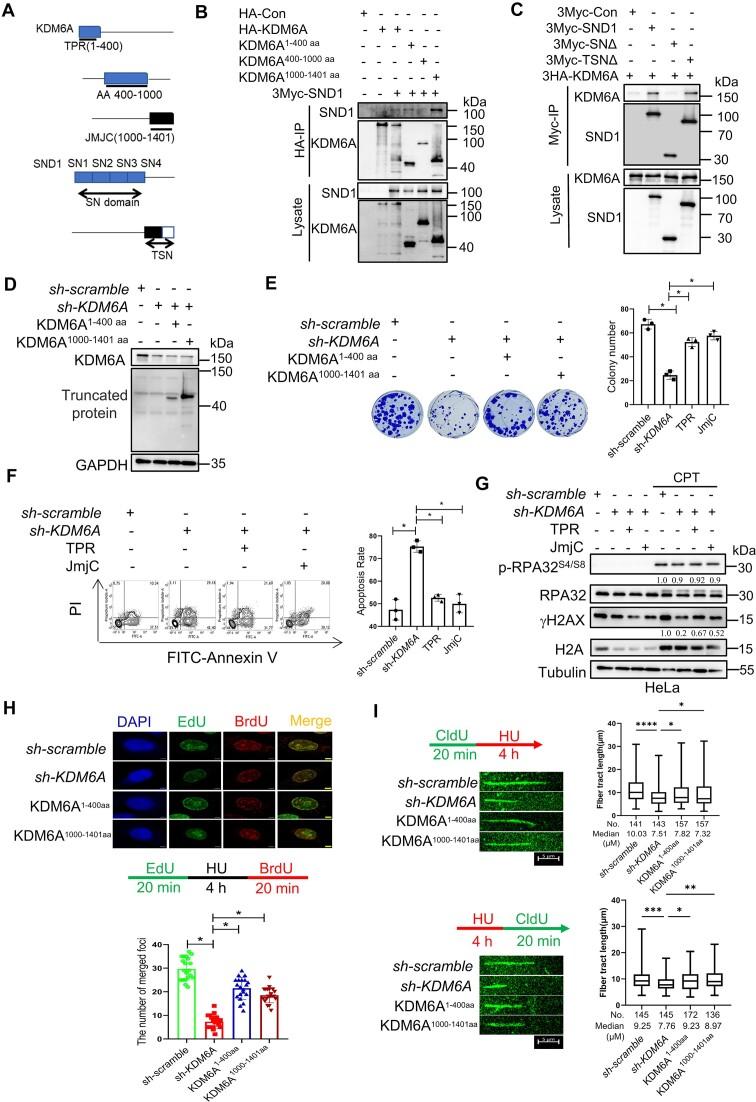
Genomic instability is one of the hallmarks of cancer. While loss of histone demethylase KDM6A increases the risk of tumorigenesis, its specific role in maintaining genomic stability remains poorly understood. Here, we propose a mechanism in which KDM6A maintains genomic stability independently on its demethylase activity. This occurs through its interaction with SND1, resulting in the establishment of a protective chromatin state that prevents replication fork collapse by recruiting of RPA and Ku70 to nascent DNA strand. Notably, KDM6A-SND1 interaction is up-regulated by KDM6A SUMOylation, while KDM6AK90A mutation almost abolish the interaction. Loss of KDM6A or SND1 leads to increased enrichment of H3K9ac and H4K8ac but attenuates the enrichment of Ku70 and H3K4me3 at nascent DNA strand. This subsequently results in enhanced cellular sensitivity to genotoxins and genomic instability. Consistent with these findings, knockdown of KDM6A and SND1 in esophageal squamous cell carcinoma (ESCC) cells increases genotoxin sensitivity. Intriguingly, KDM6A H101D & P110S, N1156T and D1216N mutations identified in ESCC patients promote genotoxin resistance via increased SND1 association. Our finding provides novel insights into the pivotal role of KDM6A-SND1 in genomic stability and chemoresistance, implying that targeting KDM6A and/or its interaction with SND1 may be a promising strategy to overcome the chemoresistance.
基因组不稳定性是癌症的标志之一。虽然组蛋白去甲基酶 KDM6A 的丢失会增加肿瘤发生的风险,但它在维持基因组稳定性方面的具体作用仍知之甚少。在这里,我们提出了一种机制,即 KDM6A 通过与 SND1 的相互作用,独立于其去甲基酶活性来维持基因组稳定性。这种作用是通过其与 SND1 的相互作用来实现的,从而建立了一种保护染色质状态,通过招募 RPA 和 Ku70 到新生 DNA 链来防止复制叉崩溃。值得注意的是,KDM6A-SND1 相互作用受 KDM6A SUMOylation 的上调调节,而 KDM6AK90A 突变几乎消除了这种相互作用。KDM6A 或 SND1 的缺失导致 H3K9ac 和 H4K8ac 的富集增加,但削弱了新生 DNA 链上 Ku70 和 H3K4me3 的富集。这随后导致细胞对遗传毒物和基因组不稳定性的敏感性增加。与这些发现一致的是,在食管鳞状细胞癌(ESCC)细胞中敲低 KDM6A 和 SND1 增加了遗传毒物的敏感性。有趣的是,在 ESCC 患者中鉴定的 KDM6A H101D 和 P110S、N1156T 和 D1216N 突变通过增加 SND1 关联促进了遗传毒物抗性。我们的发现为 KDM6A-SND1 在基因组稳定性和化疗耐药性中的关键作用提供了新的见解,这表明靶向 KDM6A 和/或其与 SND1 的相互作用可能是克服化疗耐药性的一种有前途的策略。





 Zotero 插件