
Src抑制增强急性髓系白血病中MCL-1拮抗剂的活性。
Src inhibition potentiates MCL-1 antagonist activity in acute myeloid leukemia.
作者信息
Hu Xiaoyan, Li Lin, Nkwocha Jewel, Kmieciak Maciej, Shang Shengzhe, Cowart L Ashley, Yue Yang, Horimoto Katsuhisa, Hawkridge Adam, Rijal Arjun, Mauro Adolfo G, Salloum Fadi N, Hazlehurst Lori, Sdrimas Konstantinos, Moore Zackary, Zhou Liang, Ginder Gordon D, Grant Steven
机构信息
Division of Hematology/Oncology, Department of Internal Medicine, Virginia Commonwealth University, Richmond, VA, USA.
Massey Cancer Center, Virginia Commonwealth University, Richmond, VA, USA.
出版信息
Signal Transduct Target Ther. 2025 Feb 10;10(1):50. doi: 10.1038/s41392-025-02125-x.
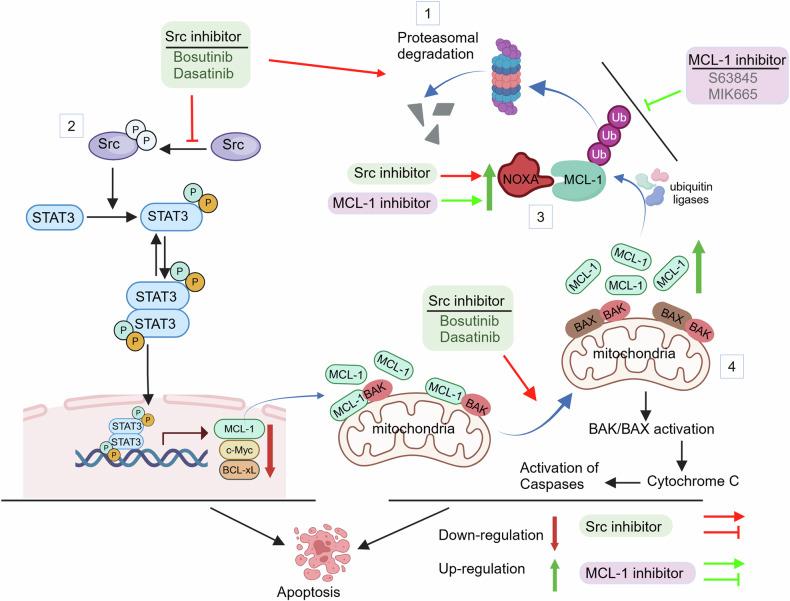
The importance of MCL-1 in leukemogenesis has prompted development of MCL-1 antagonists e.g., S63845, MIK665. However, their effectiveness in acute myeloid leukemia (AML) is limited by compensatory MCL-1 accumulation via the ubiquitin proteasome system. Here, we investigated mechanisms by which kinase inhibitors with Src inhibitory activity e.g., bosutinib (SKI-606) might circumvent this phenomenon. MCL-1 antagonist/SKI-606 co-administration synergistically induced apoptosis in diverse AML cell lines. Consistently, Src or MCL-1 knockdown with shRNA markedly sensitized cells to MCL-1 inhibitors or SKI-606 respectively, while ectopic MCL-1 expression significantly diminished apoptosis. Mechanistically, MCL-1 antagonist exposure induced MCL-1 up-regulation, an event blocked by Src inhibitors or Src shRNA knock-down. MCL-1 down-regulation was associated with diminished transcription and increased K48-linked degradative ubiquitination. Enhanced cell death depended functionally upon down-regulation of phosphorylated STAT3 (Tyr705/Ser727) and cytoprotective downstream targets c-Myc and BCL-xL, as well as BAX/BAK activation, and NOXA induction. Importantly, the Src/MCL-1 inhibitor regimen robustly killed primary AML cells, including primitive progenitors, but spared normal hematopoietic CD34 cells and human cardiomyocytes. Notably, the regimen significantly improved survival in an MV4-11 cell xenograft model, while reducing tumor burden in two patient-derived xenograft (PDX) AML models and increased survival in a third. These findings argue that Src inhibitors such as SKI-606 potentiate MCL-1 antagonist anti-leukemic activity in vitro and in vivo by blocking MCL-1 antagonist-mediated cytoprotective MCL-1 accumulation by promoting degradative ubiquitination, disrupting STAT-3-mediated transcription, and inducing NOXA-mediated MCL-1 degradation. They also suggest that this strategy may improve MCL-1 antagonist efficacy in AML and potentially other malignancies.
MCL-1在白血病发生中的重要性促使人们开发MCL-1拮抗剂,如S63845、MIK665。然而,它们在急性髓系白血病(AML)中的有效性受到泛素蛋白酶体系统介导的MCL-1代偿性积累的限制。在此,我们研究了具有Src抑制活性的激酶抑制剂(如博舒替尼(SKI-606))可能规避这一现象的机制。联合使用MCL-1拮抗剂/SKI-606可协同诱导多种AML细胞系凋亡。同样,用shRNA敲低Src或MCL-1分别使细胞对MCL-1抑制剂或SKI-606显著敏感,而异位表达MCL-1则显著减少凋亡。从机制上讲,暴露于MCL-1拮抗剂会诱导MCL-1上调,这一事件可被Src抑制剂或Src shRNA敲低所阻断。MCL-1下调与转录减少和K48连接的降解性泛素化增加有关。增强的细胞死亡在功能上依赖于磷酸化STAT3(Tyr705/Ser727)和细胞保护下游靶点c-Myc及BCL-xL的下调,以及BAX/BAK激活和NOXA诱导。重要的是,Src/MCL-1抑制剂方案能有效杀死原发性AML细胞,包括原始祖细胞,但对正常造血CD34细胞和人心肌细胞无影响。值得注意的是,该方案显著提高了MV4-11细胞异种移植模型的生存率,同时降低了两种患者来源异种移植(PDX)AML模型中的肿瘤负荷,并提高了第三种模型的生存率。这些发现表明,诸如SKI-606之类的Src抑制剂通过促进降解性泛素化、破坏STAT-3介导的转录以及诱导NOXA介导的MCL-1降解,来阻断MCL-1拮抗剂介导的细胞保护性MCL-1积累,从而在体外和体内增强MCL-1拮抗剂的抗白血病活性。它们还表明,该策略可能提高MCL-1拮抗剂在AML以及潜在其他恶性肿瘤中的疗效。


 Zotero 插件