
2019冠状病毒病大流行及相关非药物干预措施对德国其他法定传染病的影响:2016年第1周 - 2020年第32周国家监测数据分析
Impact of the COVID-19 pandemic and associated non-pharmaceutical interventions on other notifiable infectious diseases in Germany: An analysis of national surveillance data during week 1-2016 - week 32-2020.
作者信息
Ullrich Alexander, Schranz Madlen, Rexroth Ute, Hamouda Osamah, Schaade Lars, Diercke Michaela, Boender T Sonia
机构信息
Robert Koch Institute, Department for Infectious Disease Epidemiology, Seestrasse 10, 13353 Berlin, Germany.
Robert Koch Institute, Centre for Biological Threats and Special Pathogens, Nordufer 20, 13353 Berlin, Germany.
出版信息
Lancet Reg Health Eur. 2021 Jun 19;6:100103. doi: 10.1016/j.lanepe.2021.100103. eCollection 2021 Jul.
BACKGROUND
The COVID-19 pandemic and associated non-pharmaceutical interventions (NPIs) affect healthcare seeking behaviour, access to healthcare, test strategies, disease notification and workload at public health authorities, but may also lead to a true change in transmission dynamics. We aimed to assess the impact of the pandemic and NPIs on other notifiable infectious diseases under surveillance in Germany.
METHODS
We included 32 nationally notifiable disease categories with case numbers >100/year in 2016-2019. We used quasi-Poisson regression analysis on a weekly aggregated time-series incorporating trend and seasonality, to compute the relative change in case numbers during week 2020-10 to 2020-32 (pandemic/NPIs), in comparison to week 2016-01 to 2020-09.
FINDINGS
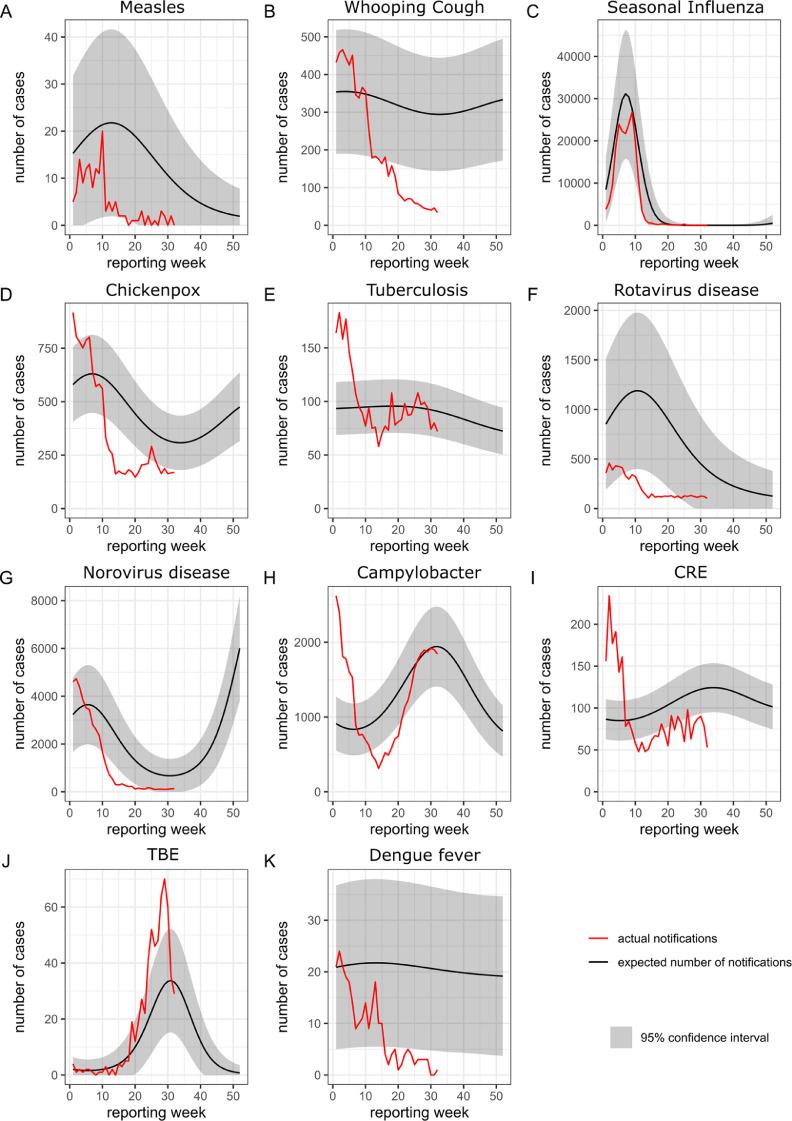
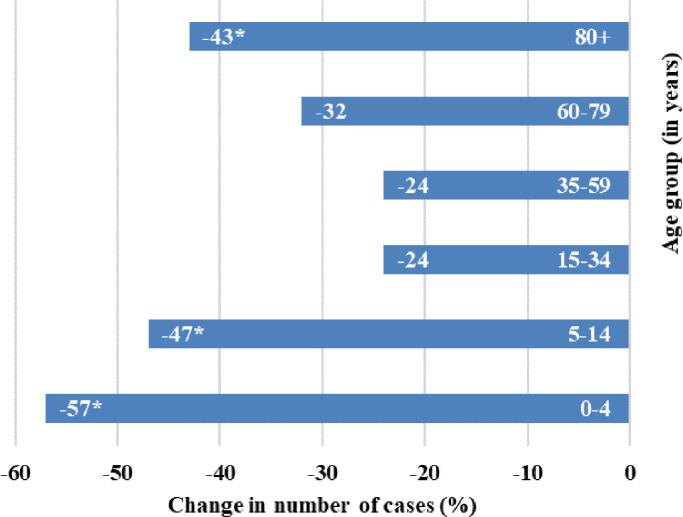
During week 2020-10 to 2020-32, 216,825 COVID-19 cases, and 162,942 (-35%) cases of other diseases, were notified. Case numbers decreased across all ages and notification categories (all <0•05), except for tick-borne encephalitis, which increased (+58%). The number of cases decreased most for respiratory diseases (from -86% for measles, to -12% for tuberculosis), gastro-intestinal diseases (from -83% for rotavirus gastroenteritis, to -7% for yersiniosis) and imported vector-borne diseases (-75% dengue fever, -73% malaria). The less affected infections were healthcare associated pathogens (from -43% infection/colonisation with carbapenem-non-susceptible , to -28% for Methicillin-resistant invasive infection) and sexually transmitted and blood-borne diseases (from -28% for hepatitis B, to -12% for syphilis).
INTERPRETATION
During the COVID-19 pandemic a drastic decrease of notifications for most infectious diseases and pathogens was observed. Our findings suggest effects of NPIs on overall disease transmission that require further investigation.
FUNDING
The Robert Koch Institute is the National Public Health Institute of Germany, and is an institute within the portfolio of the Federal Ministry of Health.
背景
2019冠状病毒病疫情及相关非药物干预措施(NPIs)影响了就医行为、医疗服务可及性、检测策略、疾病报告以及公共卫生当局的工作量,但也可能导致传播动态的真正改变。我们旨在评估疫情及非药物干预措施对德国监测的其他法定传染病的影响。
方法
我们纳入了2016 - 2019年每年病例数>100例的32种全国法定疾病类别。我们对包含趋势和季节性的每周汇总时间序列进行准泊松回归分析,以计算2020年第10周 - 2020年第32周(疫情/非药物干预措施期间)与2016年第1周 - 2020年第9周相比病例数的相对变化。
结果
在2020年第10周 - 2020年第32周期间,共报告了216,825例2019冠状病毒病病例,以及162,942例(下降35%)其他疾病病例。除蜱传脑炎病例数增加(+58%)外,所有年龄组和报告类别的病例数均下降(均<0.05)。呼吸道疾病病例数下降最多(从麻疹的 - 86%到结核病的 - 12%)、胃肠道疾病(从轮状病毒胃肠炎的 - 83%到耶尔森菌病的 - 7%)以及输入性媒介传播疾病(登革热 - 75%,疟疾 - 73%)。受影响较小的感染是医疗相关病原体(从碳青霉烯不敏感感染/定植的 - 43%到耐甲氧西林侵袭性感染的 - 28%)以及性传播和血源传播疾病(从乙型肝炎的 - 到梅毒的 - 12%)。
解读
在2019冠状病毒病疫情期间,观察到大多数传染病和病原体的报告大幅减少。我们的研究结果表明非药物干预措施对总体疾病传播有影响,需要进一步调查。
资助
罗伯特·科赫研究所是德国国家公共卫生研究所,是联邦卫生部下属的一个研究所。
 Zotero 插件