
破骨细胞与调节性 CD4 T 细胞之间的相互作用基因集可准确预测骨肉瘤患者的预后。
Interaction gene set between osteoclasts and regulatory CD4 T cells can accurately predict the prognosis of patients with osteosarcoma.
机构信息
Department of Spine and Osteopathic Surgery, First Affiliated Hospital of Guangxi Medical University, Nanning, China.
Collaborative Innovation Centre of Regenerative Medicine and Medical BioResource Development and Application Co-constructed by the Province and Ministry, Guangxi Medical University, Nanning, China.
出版信息
Cancer Sci. 2023 Jul;114(7):3014-3026. doi: 10.1111/cas.15821. Epub 2023 May 7.
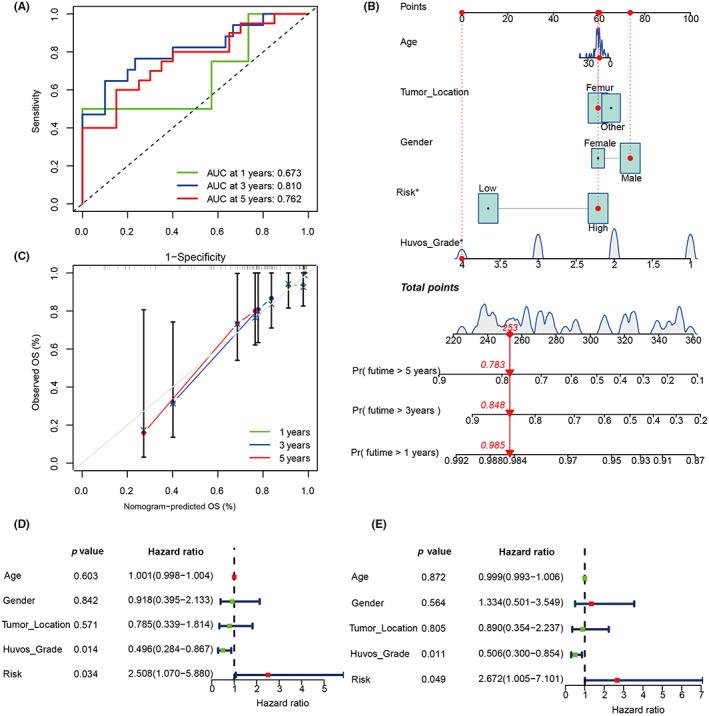
Osteoclasts (OCs) and regulatory CD4 T cells (CD4 Tregs) are important components in the tumor microenvironment (TME) of osteosarcoma. In this study, we collected six osteosarcoma samples from our previous study (GSE162454). We also integrated a public database (GSE152048), which included single cell sequencing data of 11 osteosarcoma patients. We obtained 138,192 cells and then successfully identified OCs and CD4 Tregs. Based on the interaction gene set between OCs and CD4 Tregs, patients from GSE21257 were distinguished into two clusters by consensus clustering analysis. Both the tumor immune microenvironment and survival prognosis between the two clusters were significantly different. Subsequently, five model genes were identified by protein-protein interaction network based on differentially upregulated genes of cluster 2. Quantitative RT-PCR was used to detect their expression in human osteoblast and osteosarcoma cells. A prognostic model was successfully established using these five genes. Kaplan-Meier survival analysis found that patients in the high-risk group had worse survival (p = 0.029). Therefore, our study first found that cell-cell communication between OCs and CD4 Tregs significantly alters TME and is connected to poor prognosis of OS. The model we constructed can accurately predict prognosis for osteosarcoma patients.
破骨细胞 (OCs) 和调节性 CD4 T 细胞 (CD4 Tregs) 是骨肉瘤肿瘤微环境 (TME) 的重要组成部分。在这项研究中,我们从之前的研究 (GSE162454) 中收集了 6 个骨肉瘤样本。我们还整合了一个公共数据库 (GSE152048),其中包含 11 名骨肉瘤患者的单细胞测序数据。我们获得了 138192 个细胞,并成功鉴定了 OCs 和 CD4 Tregs。基于 OCs 和 CD4 Tregs 之间的相互作用基因集,通过共识聚类分析将 GSE21257 中的患者分为两个簇。两个簇之间的肿瘤免疫微环境和生存预后均有显著差异。随后,根据簇 2 中差异上调基因的蛋白质-蛋白质相互作用网络,鉴定出五个模型基因。通过定量 RT-PCR 检测它们在人成骨细胞和骨肉瘤细胞中的表达。使用这五个基因成功建立了预后模型。Kaplan-Meier 生存分析发现,高风险组患者的生存状况较差 (p=0.029)。因此,我们的研究首次发现,OCs 和 CD4 Tregs 之间的细胞间通讯显著改变了 TME,并与 OS 的不良预后相关。我们构建的模型可以准确预测骨肉瘤患者的预后。


 Zotero 插件